How Korea's templestay programs turned monastic quiet into a wellness export
Korean Buddhism's templestay network began as an improvised fix for a World Cup lodging shortage and became a durable soft-power and wellness product, thriving even as religious affiliation itself declines.
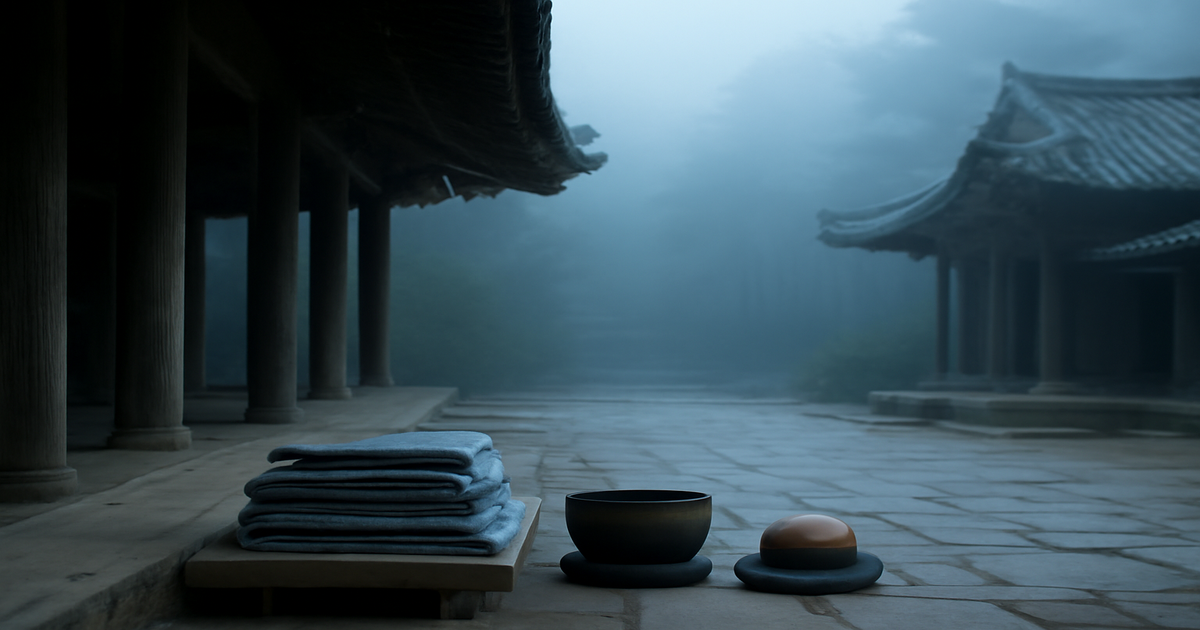
A templestay is a strikingly minimal product. A guest arrives at a mountain temple in the afternoon, changes into loose vest-and-trouser temple clothes, learns to bow and to hold a bowl, eats a vegetarian meal in silence, walks a forest path, sleeps on a heated floor, and wakes before dawn to the sound of the moktak. Nothing about this is new; monastics have been doing it for centuries. What is new is the packaging — the reservation system, the bilingual orientation, the standardized fee, the certified participating temple. That packaging is the real innovation, and it explains why templestays have grown into one of Korea’s more successful cultural exports at precisely the moment institutional Buddhism is losing followers.
The origin story is unglamorous and often retold: as Korea prepared to co-host the 2002 World Cup, planners faced a shortage of accommodation for foreign visitors, and the Jogye Order — the dominant Korean Buddhist order — opened a set of temples to overnight guests. What could have been a one-off logistical favor was instead institutionalized. The order built out a dedicated body to manage the program, developed training for the monks and lay coordinators who host guests, and secured public cultural funding on the grounds that temples are custodians of national heritage as much as of doctrine. Within two decades the program covered a network of temples spread across the country, from famous mountain complexes to small hermitages reachable only by a long uphill walk.
The crucial design decision was that no one is asked to convert. Programs are generally sorted into experience-type stays, with structured schedules of chanting, tea ceremony, lotus-lantern making and 108 prostrations, and rest-type stays, which amount to little more than a room, meals and permission to do nothing. The second category is the quietly radical one. It reframes a monastery as infrastructure for recovery rather than a site of belief, and it maps neatly onto a global wellness vocabulary of digital detox, forest bathing and mindfulness. A visitor can consume the aesthetic and the discipline of Korean Buddhism without accepting a single metaphysical claim, and the host institution has decided that this is an acceptable exchange.
This decoupling is why the program’s health does not track the health of Korean Buddhism. Successive government surveys of religion have documented a broad rise in the share of Koreans reporting no religious affiliation, with the decline sharpest among younger cohorts, and Buddhism has been particularly exposed because its adherents skew older and its membership is often loose and inherited rather than congregational. Temples facing thinning donation bases and aging parishioners have found in templestays a revenue line, a public-relations asset and a pipeline of goodwill that does not depend on anyone becoming a Buddhist. Religion, in this arrangement, survives partly by converting itself into heritage and hospitality.
The domestic market matters more than the export framing suggests. Korean guests come with a specific complaint — exhaustion produced by long hours, dense cities, and a culture of comparison that leaves little room for unstructured time. A weekend in which the schedule is imposed by a bell rather than chosen is, paradoxically, experienced as freedom. Foreign guests arrive with a different appetite, shaped by the wider Korean wave: having encountered Korea through music, television and food, some want a version of the country that feels older and slower, and mountain temples supply it. Tourism authorities have been happy to promote this, since it distributes visitors beyond Seoul and into provinces that struggle to attract them.
The frictions are real. Hosting guests is labor, performed by a shrinking and aging monastic population, and some senior monks have questioned whether contemplative training survives the arrival of paying visitors with expectations. There are long-running disputes over temple admission fees inside national parks, and unresolved questions about how much foot traffic fragile wooden halls and mountain trails can absorb. Still, the model has proved unusually portable, because what it sells is not doctrine but atmosphere — and atmosphere, once standardized, travels.