South Korea leans on soldiers and aging volunteers as longer, hotter wildfire seasons outpace its forestry agencies
South Korea's spring wildfires, intensified by drier conditions and dense pine forests, increasingly depend on military helicopters and troops because forestry crews and rural volunteer firefighters are stretched thin.
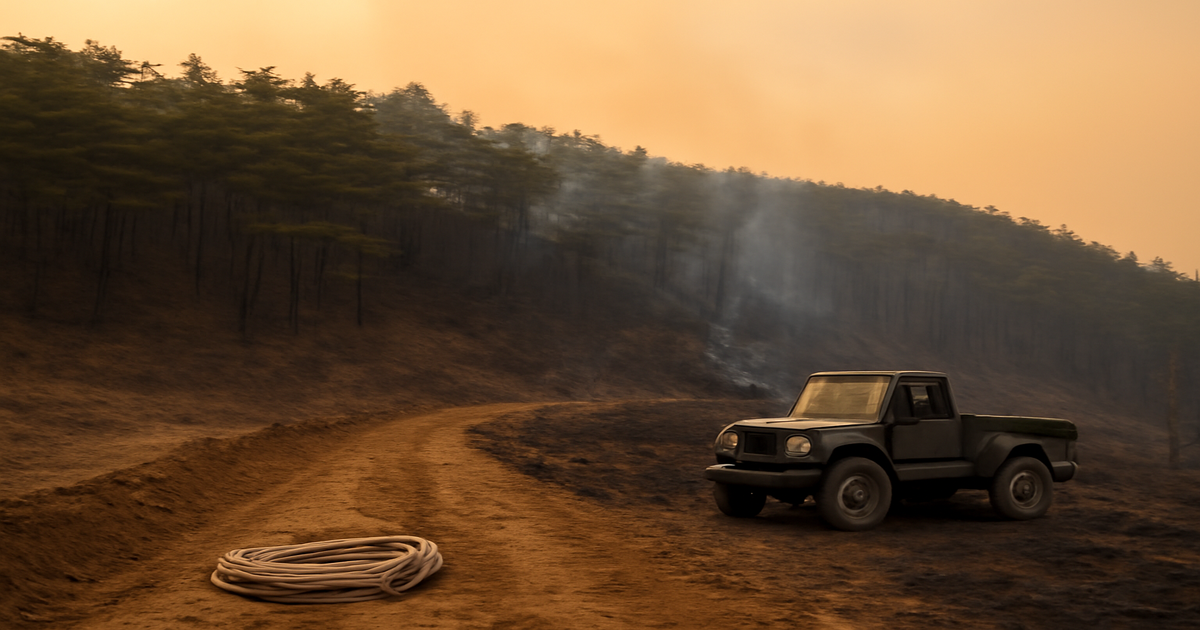
Every spring, as the dry season settles over the Korean Peninsula, the east coast of Gangwon Province and the hills of North Gyeongsang become some of the most fire-prone landscapes in East Asia. Low humidity, dead winter vegetation and a strong, warm downslope wind that funnels between Yangyang and Gangneung can turn a discarded cigarette or a burning field into a front that jumps ridgelines in minutes. The resulting fires have repeatedly tested the country’s emergency system, from the blaze that destroyed much of Naksansa temple in 2005 to the Goseong-Sokcho fire of 2019, the vast Uljin-Samcheok fires of 2022, and the deadly fires that swept across Uiseong and Andong in 2025.
The legal responsibility for fighting forest fires rests mainly with the Korea Forest Service, which operates its own fleet of firefighting helicopters and coordinates regional responses with provincial and local governments. Structural firefighting falls to the National Fire Agency, which became a fully national service only around 2020. In practice, however, large fires quickly exceed what either body can handle alone, and that is where the armed forces enter. Under Korea’s disaster management framework, civilian authorities can request military support, and in major fires the Army and Air Force routinely send heavy-lift helicopters such as Chinooks and domestically built Surions, along with thousands of soldiers on foot.
Soldiers rarely fight the main fire front. Their most valuable work comes afterward and on the margins, digging firebreaks, hauling hoses up steep slopes, and patrolling burned hillsides to stamp out smoldering embers that can reignite when the wind returns. This residual fire work is grueling and labor-intensive, exactly the kind of task a conscript army with large numbers of young personnel can perform at scale. Military bases scattered across mountainous Gangwon also mean troops are often physically closer to remote fires than civilian crews are.
The heavier reliance on the military reflects strains in the civilian system. Much of the frontline labor for forest fires comes from seasonal forest fire specialist crews and from volunteer firefighter units in rural towns and townships. Both draw heavily on local residents, and in Korea’s countryside those residents are disproportionately older. Depopulation has hollowed out many of the villages that once supplied able-bodied volunteers, leaving crews in which people well past middle age climb steep terrain carrying equipment. Meanwhile, the Forest Service’s own helicopters, while numerous, have at times included aging airframes, and night operations remain difficult in the steep, smoky valleys where fires tend to spread.
The landscape itself adds pressure. Korea’s postwar reforestation campaign is widely regarded as a success, but it produced dense, continuous stands of conifers, especially Korean red pine, whose resin-rich needles burn intensely. Climate shifts appear to be lengthening the dry period and raising spring temperatures, so the season of serious risk tends to start earlier and linger later than older planning assumed. Fires that once would have been contained in a day can now persist for a week or more, exhausting crews and requiring rotation of personnel the civilian system struggles to supply.
This creates a quiet dependency with uncomfortable implications. Korea’s armed forces face a shrinking pool of conscripts as the birth rate falls, and every unit diverted to firefighting is one not training for its primary mission on a still-divided peninsula. Military helicopter crews are also not specialists in aerial firefighting, and coordination across separate command structures can slow decisions at the moments speed matters most.
The debate in Korea increasingly centers on whether to keep improvising with soldiers and volunteers or to build a larger professional wildfire force, invest in more capable aircraft, and manage forests more actively with thinning and mixed broadleaf planting. Most policymakers seem to accept that the military will remain part of the answer. The harder question is whether it should remain the reserve that civilian institutions quietly assume will always be available.