Screen golf turned a rich man's game into an after-work habit in Korea
Indoor simulator golf, built around cheap hourly rooms in commercial buildings, dismantled the cost and time barriers that once made golf a preserve of Korean executives — and changed who plays the outdoor game too.
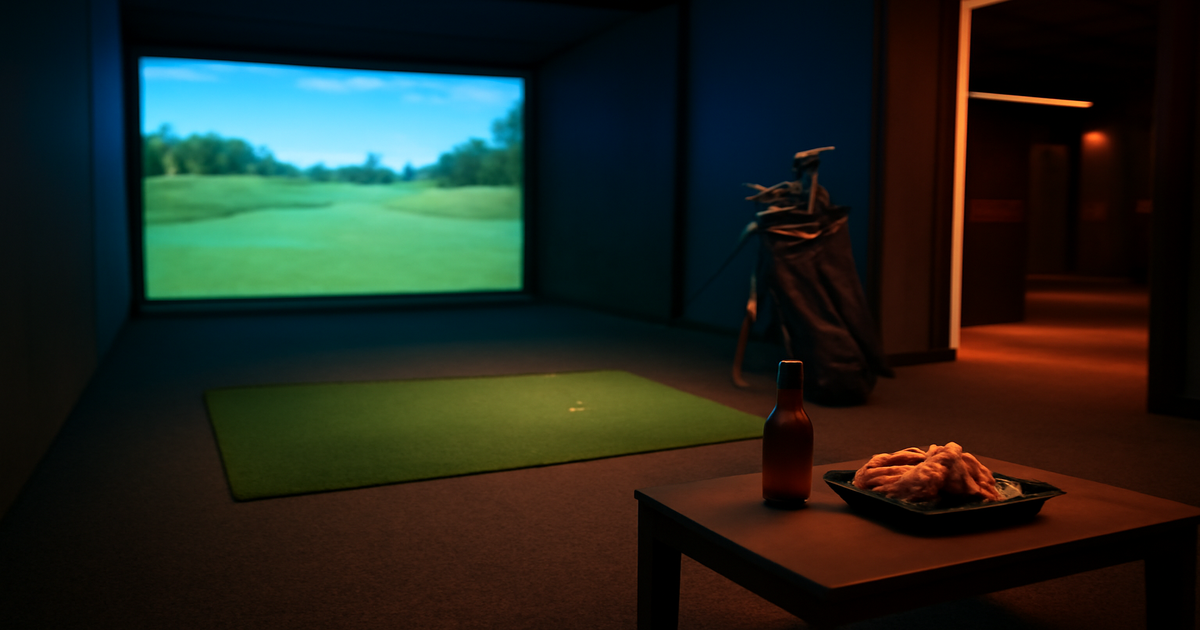
Walk past the illuminated signage stacked up the side of almost any mid-sized Korean commercial building and somewhere between the billiards hall, the study café and the barbecue restaurant there will be a screen golf room. Inside, a few bays face projection screens, each with a sensor mat and a rack of borrowed clubs, rented by the hour at prices comparable to a couple of rounds of drinks. This is the physical infrastructure of a sport that, within living memory, most Koreans encountered only as something their company president did on Saturdays.
The barriers that screen golf removed were specific rather than vague. Real golf in Korea is expensive not because Koreans are unusually fond of luxury but because mountainous terrain makes course construction costly, land is scarce, and the membership-deposit system historically locked access behind large refundable payments that only firms and wealthy individuals could front. On top of green fees came caddie fees, cart fees, the near-mandatory foursome, the drive out of the city, and the meal afterward. A round consumed most of a day and a meaningful share of a monthly salary. That combination made golf legible as a class marker — a signal that you had both the money and, more tellingly, the discretionary time.
Simulator golf attacked the time cost first. A round on screen takes a couple of hours, fits after work, needs no tee-time booking weeks ahead, and is indifferent to Korea’s monsoon summers and hard winters. It also attacked the social cost. Screen golf rooms sit inside the same nighttime economy as noraebang and hof bars, and they inherited its conventions: you play with colleagues, you order fried chicken and beer to the bay, you settle a small wager, you leave. The technology — Korean firms, most prominently Golfzon out of Daejeon, built the dominant simulator systems from the early 2000s onward — mattered less than the fact that the format matched an existing pattern of Korean sociability.
The result was a genuine widening of the player base, and the composition of that base is the interesting part. Screen golf lowered the entry cost for people in their twenties and thirties who would never have been invited onto a corporate outing, and for women, who had been underrepresented on courses partly because of the sport’s association with male business networking. Korea’s long run of success on the LPGA tour, beginning with Park Se-ri’s era and sustained by a deep domestic KLPGA circuit, had already made professional golf a mainstream television product with visible female stars. Screen golf gave the audience a place to actually swing a club without a sponsor or a membership.
It also became an economic sector in its own right. Franchised screen golf outlets are a familiar second act for retirees and mid-career leavers entering Korea’s crowded self-employment market, alongside cafés and convenience stores — low technical barrier, standardized equipment package, and a business that runs on evening foot traffic. Equipment makers, golf apparel brands and driving ranges all fed on the same expansion, and golf clothing in particular became a visible fashion category rather than functional kit, which tells you the participants were treating it as identity rather than exercise.
The boom peaked under pandemic conditions, when overseas travel stopped and outdoor, distanced leisure absorbed spending that had nowhere else to go. Green fees rose sharply in that window, and some of the new demand has since drifted toward tennis, running and other cheaper hobbies. What has not reversed is the underlying reclassification. Golf in Korea is no longer a sport you need permission to enter; it is a thing people do in a basement on a Tuesday, which is a different sport entirely, even when the swing is the same.