Korea sorts its waste diligently and recycles less than it thinks
Household separation discipline is world-class, but the share of sorted material that becomes new product is far smaller than the headline recycling rate suggests.
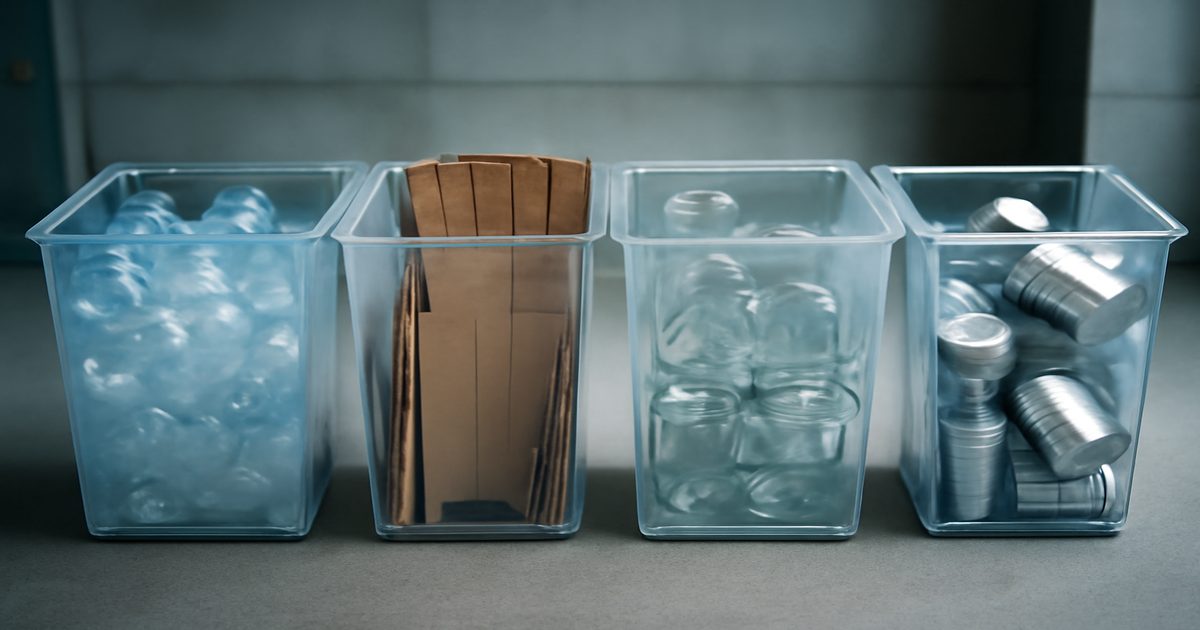
Few countries ask as much of their households at the bin as Korea does. Residents buy municipal-issue bags for general refuse under the volume-based charging system introduced in 1995, separate paper, glass, metal, plastic film and rigid plastic into labelled containers, rinse and crush transparent drink bottles into their own stream under a rule phased in from December 2020, and weigh their food waste into metered collection units. Apartment complexes hold designated recycling days with residents supervising the sort. Compliance is high and largely unforced. On the input side, the system works.
The output side is where the accounting turns slippery. Korea routinely appears near the top of international recycling league tables, with household recycling rates commonly reported around 60 percent or higher depending on the method used. That figure measures material delivered to recycling facilities, not material that leaves them as usable feedstock. Once sorting losses, contamination and residue are subtracted, the share of collected household plastic that actually re-enters manufacturing as recycled material has been estimated by environmental researchers and civic groups at well under half of what is collected. The remainder is burned for energy, converted into solid recovered fuel, or landfilled.
Several structural reasons sit behind the gap, and none of them is household laziness. Much Korean packaging is multi-layer or composite — pouches, metallized film, labelled and coloured bottles — and cannot be economically separated into a single polymer. Small-quantity streams from single-person households, which now make up the largest household type in the country, arrive mixed and contaminated. And the value of recovered material tracks oil prices, so a period of cheap virgin resin can render an entire collection stream commercially worthless while collection continues unchanged.
The financing structure is meant to absorb some of that. Under the extended producer responsibility scheme in force since 2003, companies that place packaging on the market must meet recycling obligations for it or pay into a system that does the work on their behalf. It has raised collection volumes reliably. What it has been weaker at is changing what gets designed in the first place, since the obligation attaches to tonnage recovered rather than to whether a package can be recovered at all — which is why the transparent-bottle and label-removal rules, aimed squarely at design, mattered more than their modest appearance suggested.
Food waste is the system’s genuine success and its most instructive case. Direct landfilling of food waste was ended in 2005 and ocean dumping in 2013, forcing the country to build treatment capacity. Metered collection, increasingly through RFID-equipped bins that identify the household and charge by weight, gave every kitchen a direct financial signal, and reported diversion of food waste to animal feed, compost and biogas runs around 90 percent. The measured drop in waste generated per household after RFID metering is one of the clearest demonstrations available anywhere that pricing a waste stream at the point of disposal changes behaviour. Quality of the output — feed and compost markets are finicky about salt and contaminants — remains the weak link.
Disposable cups have proved harder. A deposit-return scheme requiring a 300-won refundable charge on takeaway cups began in December 2022, but was launched only in Jeju and Sejong rather than nationwide after objections about the burden on small franchise operators, and return rates in the pilot areas were mixed. The episode illustrates the recurring pattern: Korea can mobilize household compliance almost at will, and struggles far more with the industrial and commercial links downstream, where the material actually decides whether it becomes a product or a fuel.
The honest ledger, then, shows a country that is exceptionally good at the part of recycling that depends on civic habit and considerably less good at the part that depends on packaging design, stable markets for recovered material and treatment capacity. Both halves count. Only one of them is visible from the bin.