How fine dust rearranged the Korean calendar
Seasonal fine particulate pollution turned air-quality forecasts into a daily household decision, and a decade of measurement shows both genuine improvement and a level still far above what the WHO advises.
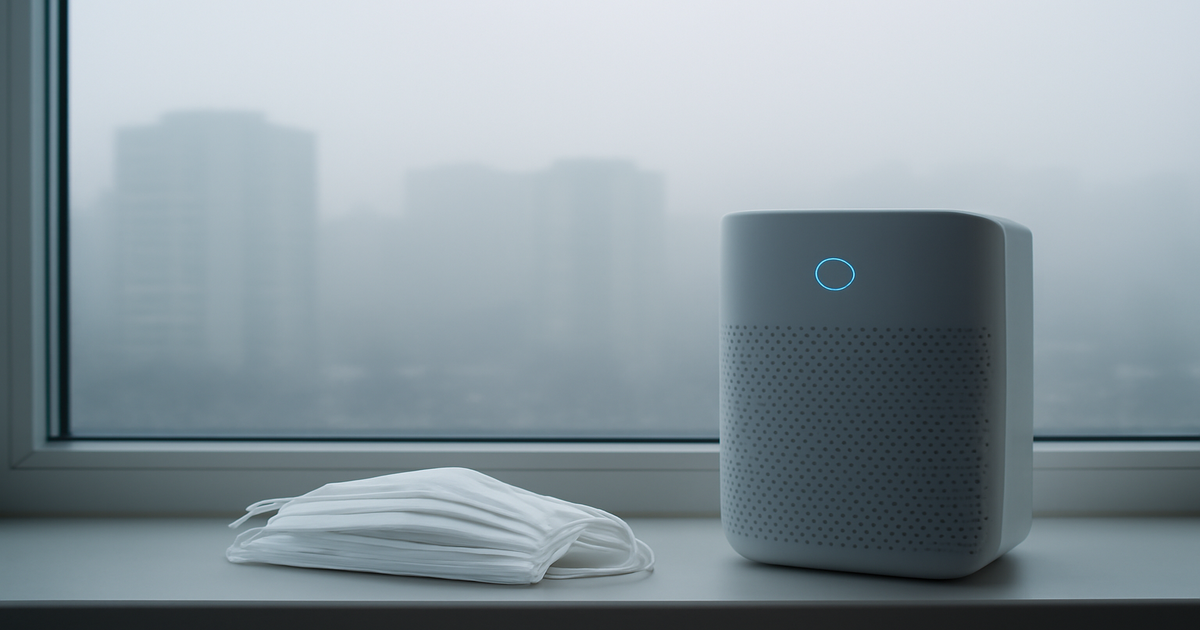
Korean households check the air the way other countries check rain. Weather applications lead with a fine-dust index rather than temperature during the cold months, schools decide whether outdoor physical education happens on the basis of a forecast issued the evening before, and a supply of filtering masks is a normal household item independent of any epidemic. The vocabulary has settled too: misemeonji for particulates below 10 micrometres, chomisemeonji for the finer fraction below 2.5, terms that ordinary people use with a precision usually reserved for specialists.
The measured record supports both halves of the public mood. When nationwide monitoring of the fine fraction began in 2015, the national annual average sat in the mid-twenties in micrograms per cubic metre; environment ministry figures have put it closer to 18 in more recent years, a decline of roughly a third across the series. That is real improvement by any standard. It is also more than three times the 5 micrograms per cubic metre the World Health Organization adopted as its air quality guideline in 2021, and the annual average conceals a seasonal distribution in which the worst days are concentrated between December and March, when stagnant high-pressure systems sit over the peninsula, heating demand peaks, and prevailing westerlies arrive over the industrial belt of northeast Asia.
The question of where the particulates originate has been the most politically charged part of the subject and the least productive. A joint research report by Korea, China and Japan published in 2019 attributed roughly half of Seoul’s fine particulate concentration to domestic sources on an annual average, with about a third traced to Chinese emissions and a small remainder to Japan. The finding satisfied no one: it was too high for those who preferred to treat the problem as imported and too low for those who wanted domestic industry left alone. Both readings miss the operational point, which is that the domestic half is the half Korea controls, and that transboundary transport is worst precisely on the days when domestic conditions are also worst.
Policy has concentrated on those days. A seasonal management system introduced in December 2019 applies stricter rules from December through March: coal-fired generating units are shut down or run below capacity, older diesel vehicles face driving restrictions in metropolitan areas, construction sites and ports operate under dust controls, and industrial emitters accept tightened limits for the period. Measured concentrations during the managed months have fallen relative to preceding winters, though disentangling the policy effect from the sharp reduction in economic activity across the region in 2020 remains genuinely difficult, and the ministry’s own evaluations acknowledge as much.
The effects that do not appear in the ministry’s tables are the ones households talk about. Air purifiers became standard in apartments and classrooms. Outdoor markets, sports and school excursions acquired a contingency plan. Ventilation habits inverted, so that windows stay closed on clear-looking days when the index is high. Quality-of-life surveys in Korea have repeatedly found air quality among the most-cited environmental complaints, ranking above noise and water, and the complaint is strongest in the metropolitan areas where most of the population lives.
What makes fine dust an unusual environmental problem is its visibility and its cadence. A pollutant with a daily forecast, a colour-coded scale and an immediate behavioural consequence generates public pressure that slower-moving problems do not. The improvement in the numbers is a product of that pressure. So is the persistent sense, on a grey February morning, that not enough has changed.