Twenty Korean universities form basic-research council as NSF funds six materials centers
The 20 university teams funded under Korea's G-LAMP program launched a joint council in Daegu and adopted a declaration on shared research resources, days after the U.S. National Science Foundation committed $108 million to six university materials research centers.
The 20 university project teams funded under Korea’s University Basic Research Institute support program, known as G-LAMP, held a launch ceremony for a joint council in Daegu on Aug. 6 and adopted a common declaration, according to a press release from the G-LAMP Consortium Council.
The day’s program ran from the launch ceremony through a policy roundtable, a meeting of project directors and the working committee, and a presentation of future plans, the release said. Directors of all 20 project teams attended alongside officials from the Ministry of Education and the National Research Foundation of Korea, with congratulatory remarks from Chae Hong-jun, head of the ministry’s academic research policy division, and Heo Jung-eun, head of the NRF’s academic promotion headquarters. Lee Hyun-sik, a professor at Kyungpook National University, was named the council’s first chair, and participants declared the body formally launched with an electronic button performance after adopting the declaration.
The declaration commits the teams to building a creative and challenging research ecosystem, strengthening the research capacity of university institutes and supporting early-career researchers, expanding information exchange and joint research between project teams as well as mobility for researchers, graduate students and postdoctoral fellows, and sharing human and physical research resources through an open collaboration network. It also calls for joint promotion of program results, cooperation with related agencies and research-funding consultative bodies, responses to a changing research environment through AI and digital technologies, international cooperation and convergence research, and proposals for institutional and policy improvement.
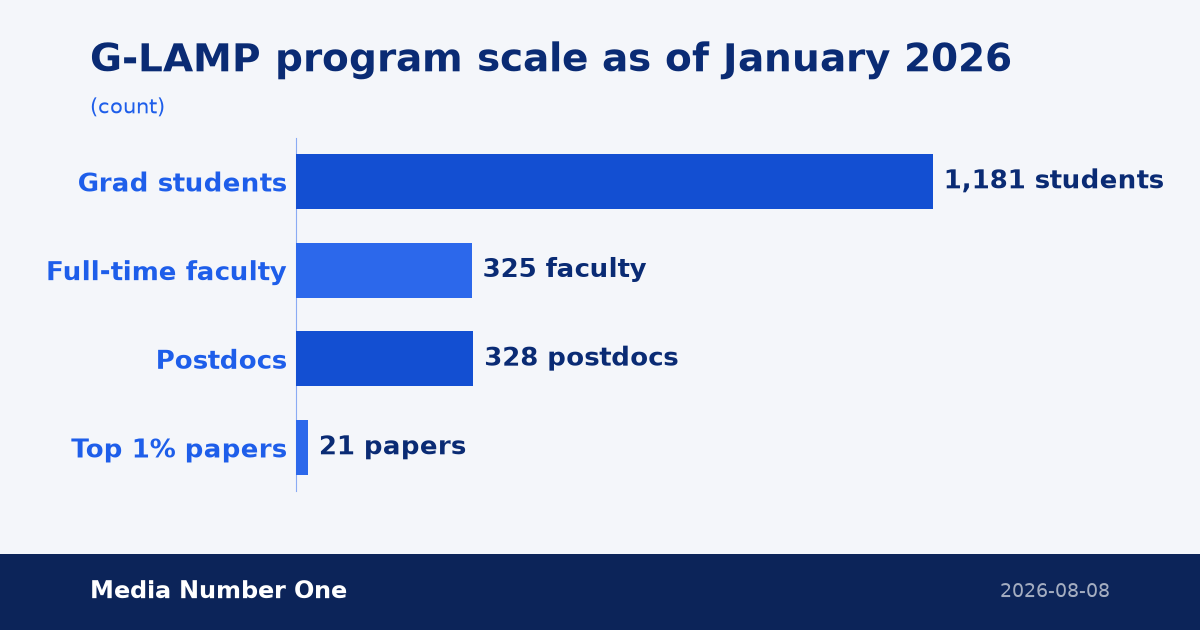
The council released figures on the program’s scale: 1,181 master’s and doctoral students as of January 2026, 325 G-LAMP full-time faculty and 328 postdoctoral researchers, 21 papers in journals ranked in the top 1% by Journal Citation Reports, and more than 623 collaborative research projects with outside institutions. G-LAMP, described in the release as a large state-funded project supported by the Ministry of Education and the NRF with the aim of innovating the basic science research ecosystem, began in 2023 with eight universities and added four new institutions in 2026, reaching a cumulative 24 universities and a total of 110 billion won.
At the policy roundtable, presentations covered the program’s current status, policy direction and an advancement strategy, and organizers gathered views from the field on operating difficulties, improvements to the evaluation system and the institutionalization of a follow-up program, the release said. The council said it plans to work with the ministry and the NRF in cultivating talent in basic science.
The same questions of scale and continuity are being answered differently in the United States. On July 30 the U.S. National Science Foundation announced $108 million for six materials science research centers, $18 million each over six years, under its Materials Research Science and Engineering Centers program, which the agency said traces back to the Materials Research Labs of the 1970s and was renamed MRSEC in the 1990s. The centers, located at higher education institutions in five states — one of them covered by NSF’s EPSCoR program — involve more than 20 partner organizations including research institutes, technology companies, education groups, several Department of Energy national laboratories and the National Institute of Standards and Technology, according to NSF.
NSF said the six centers will support more than 60 early-career researchers, more than 150 graduate students and more than 250 undergraduates, a talent pipeline comparable in intent to the 1,181 graduate students and 328 postdoctoral researchers counted by the Korean program. Research lines include hybrid particle materials that fuse light and matter, soft materials for precise drug delivery inside the body, and more sensitive scintillators that glow in response to X-rays, which the agency said could reduce X-ray exposure during CT imaging and lower the risk from repeated scans in screening and treating childhood cancers. Remarks from Tie Luo, head of NSF’s mathematical and physical sciences division, were included in the announcement.