EU releases selection results for Erasmus+ calls funding a joint European degree
The European Commission has published the outcome of two Erasmus+ calls worth a combined 22 million euros that fund exploratory work on a joint European degree label and about 14 pathway projects.

The European Commission has published the selection results for two Erasmus+ calls for proposals underpinning its work on a joint European degree, according to a document posted on the Commission’s European Education Area website. The document is dated July 15, 2026, and was posted on July 16, 2026, and covers both the European Degree exploratory action and the European Degree pathway projects. It is available in English only.
The two schemes had been presented in detail earlier in the year at an online information session held by the European Education and Culture Executive Agency, or EACEA, on Jan. 13, 2026. According to the agency, the session introduced the calls to prospective applicants and set out their budgets, priorities and eligibility rules.
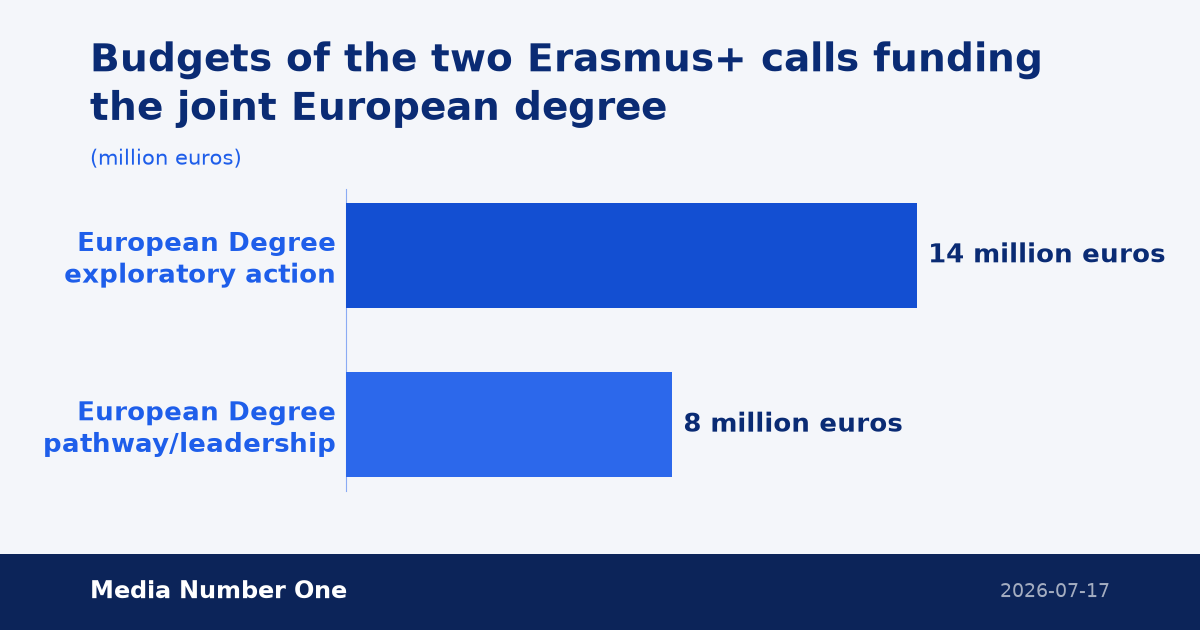
The larger of the two, the Excellence Partnerships strand for European Universities covering the European Degree exploratory action (reference ERASMUS-EDU-2025-PE-EUED), carries a budget of 14 million euros, EACEA said. The action is intended to support the spread of a joint European degree label among higher education institutions across Europe, funding activity to bring existing joint programmes into line with the label’s criteria or to design new programmes to meet them. The agency added that the action also encourages exploratory projects assessing the feasibility and the benefits of a European engineering degree.
The second call, Innovation Partnerships for forward-looking projects in higher education (ERASMUS-EDU-2025-PI-FORWARD-HE), has a budget of 8 million euros, according to EACEA. It funds two things: the European Degree pathway projects and a leadership programme to establish a European Leadership Academy. Around 14 pathway projects are to be supported, allowing public and private organisations in education and training to develop innovative approaches leading to a joint European degree, with priority given to key fields such as engineering.
The European Leadership Academy strand, EACEA said, is meant to equip leaders of higher education institutions to respond to societal challenges including the digital and green transitions. Eligibility for the forward-looking call extends to higher education institutions, public and private organisations active in education and training, and associations involved in quality assurance.
Taken together, the two calls commit 22 million euros to the same objective — replacing a patchwork of separately accredited joint programmes with degrees recognised on common European criteria. The Commission’s newly published results document records which applicants were selected under each strand.