Korean shipyards won the orders and then went looking for welders
A shipbuilding recovery that began in 2021 collided with a workforce roughly half the size of its 2014 peak, pushing yards toward foreign hiring and exposing the subcontracting structure beneath the industry.
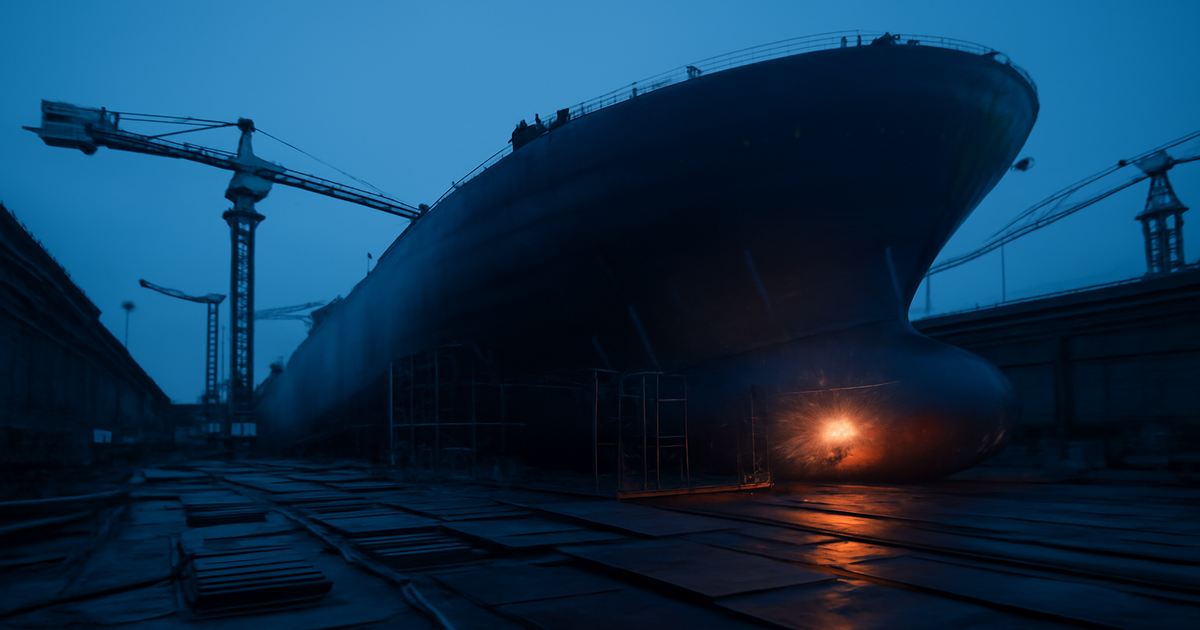
Korean shipbuilders spent the second half of the 2010s losing money and the early 2020s turning away work. The reversal came from liquefied natural gas: a wave of orders for LNG carriers, in which Korean yards hold a commanding share of global capacity, filled order books from 2021 onward and pushed delivery slots years into the future. Selective order-taking became the industry’s stated strategy, which is a comfortable position for a shipbuilder and an unfamiliar one after the preceding decade.
The problem was that the workforce had not waited. Industry association figures put employment across Korean shipbuilding at roughly 200,000 in 2014 and at about half that by 2021, the trough of a restructuring that closed docks, unwound the offshore plant business and pushed several yards through creditor-led reorganisation. Welders, fitters, painters and scaffolders who left during those years moved into construction, plant maintenance and semiconductor fab work, sectors that paid better for comparable skill and offered work that did not depend on a shipping cycle. When the orders returned, the yards discovered that a trade is not a tap.
Understanding why they did not come back requires looking at how yard labour is organised. The large builders directly employ engineers, planners and a core of skilled staff, while the bulk of production work is performed by in-house subcontractors — separate companies operating inside the yard, often layered several tiers deep, whose workers are paid on rates negotiated between the contractor and the shipbuilder. The structure gives the industry the flexibility to absorb a cyclical order book, which is precisely what it was designed for. It also means that when margins compressed during the downturn, the compression passed down the chain to the people holding the welding torch, and the wage gap between direct and subcontracted workers widened well before the recovery. A prolonged occupation of a dock at the Okpo yard by subcontracted workers in 2022, over the restoration of pay cut during the lean years, made that structure visible to a public that had not thought about it.
The response has been to import labour. The government expanded the E-7 skilled-worker visa route for shipyard welders and painters in 2023, raising quotas and shortening processing times so that yards could bring in workers from Southeast Asia and Central Asia within months rather than a year. Thousands entered on that route, and the yards, together with the industry association, built training and language programmes to absorb them. The measure worked as a stopgap. Its weakness is retention: a visa tied to an employer in a high-cost coastal city, in an industry with a well-documented cycle, competes against domestic sectors that will hire the same skills without the paperwork.
Domestic training programmes have run into a related wall. Publicly funded courses that pay a stipend to trainees who complete welding certification have produced graduates in reasonable numbers; a significant share of them leave the yards within the first year. Instructors and yard managers describe the same reasons — accommodation, shift patterns, the physical conditions of hull work, and the knowledge that the last downturn ended careers.
The deeper lesson concerns how the industry priced its competitiveness. Korean yards won global share on productivity and on a labour cost structure that assumed workers would be available when needed and absorbable when not. That assumption held while a large cohort of skilled tradespeople had no better alternative. It does not hold in an economy with a shrinking young workforce and rising outside options, and no order book, however long, substitutes for it.