What the 52 hour workweek changed and what it did not
Korea cut its legal weekly maximum from 68 hours to 52 in 2018, and the seven years since have been a continuous negotiation over the exceptions.

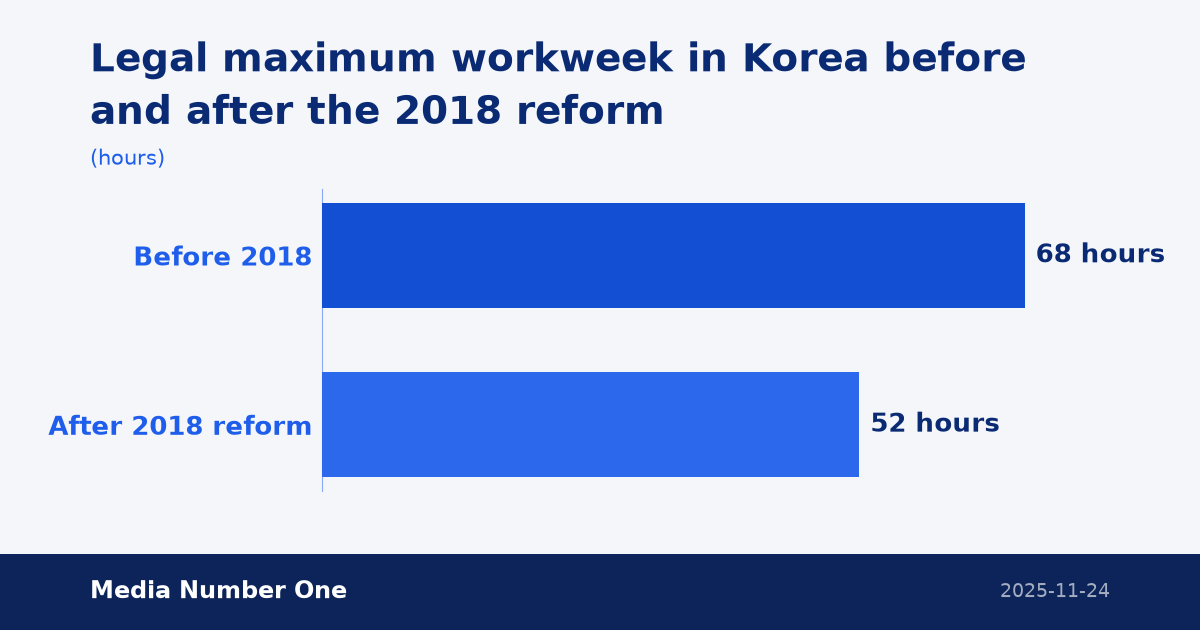
Until 2018, a Korean employee could legally work 68 hours a week. The Labour Standards Act set a 40-hour week with up to 12 hours of overtime, but an administrative interpretation treated weekend work as separate from that cap, adding a further 16 hours. A revision passed in early 2018 eliminated the loophole, fixing the maximum at 52 hours — 40 regular plus 12 overtime, weekends included. The change was phased in by employer size: firms with 300 or more employees from July 2018, those with 50 to 299 from January 2020, and those with five to 49 from July 2021.
The measurable effect was real but partial. OECD comparisons put average annual hours worked in Korea at roughly 1,870 in 2023, down from well above 2,000 a decade earlier and continuing a long decline that predates the 2018 reform. That figure still sits meaningfully above the OECD average near 1,740 and among the highest in the bloc, though the gap has narrowed considerably. The reform’s clearest achievement was compressing the upper tail: the routine 60-hour weeks that characterised parts of Korean manufacturing and office life became legally impossible at large employers, and enforcement gave that prohibition teeth.
The costs were distributed unevenly. For hourly and shift workers who had relied on overtime premiums, the cap reduced take-home pay, and the resulting income gap was a genuine grievance rather than a rhetorical one — some workers responded by taking second jobs, which reduced hours on paper and not in fact. For small manufacturers facing chronic difficulty hiring, the cap constrained output during demand peaks, since the alternative to overtime is staff they cannot find. Sectors with seasonal or project-driven workloads — construction, shipbuilding, research and development, film production — reported the sharpest mismatch between a weekly ceiling and a lumpy workload.
The system’s answer was flexibility schemes rather than a higher ceiling. A flexible working hours arrangement, which averages hours across a settlement period, was extended to six months in 2021, and the selective scheme allowing employees to distribute their own hours was lengthened to three months for research and development work. Employers may also apply for special extension approvals for defined emergencies, and the number of such approvals granted rose substantially through the early 2020s. Each of these preserves the 52-hour average while relaxing the week as the unit of measurement.
Pressure to go further has been persistent and unresolved. A 2023 government proposal to allow overtime to be managed over monthly, quarterly or annual units — which in principle would have permitted weeks of up to 69 hours during peak periods — met sustained public opposition, particularly from younger workers who doubted that the compensating rest days would materialise, and it was shelved for reconsideration. The specific arguments have shifted since toward narrower carve-outs for semiconductor research and other high-skill technical work, where the case is framed in terms of international competition rather than general labour policy.
Underlying the debate is a measurement problem. Korea has no comprehensive legal requirement for objective recording of working time, so compliance is assessed largely from payroll and self-reported schedules. In white-collar workplaces where overtime is unpaid and informally expected, the cap constrains what can be recorded more reliably than what is worked. Surveys by labour research institutes have repeatedly found reported hours below actual ones in office employment.
What the reform did accomplish is a shift in the default. Long hours in Korea are now an exception requiring justification, scheme approval or concealment, rather than the assumed condition of employment. That is a smaller change than the headline number implies and a larger one than the persistence of high average hours suggests.