The price of a cabbage and the politics of the Korean table
Napa cabbage prices swing violently with the weather, and because kimchi sits on nearly every Korean table, those swings become a national economic story each autumn.
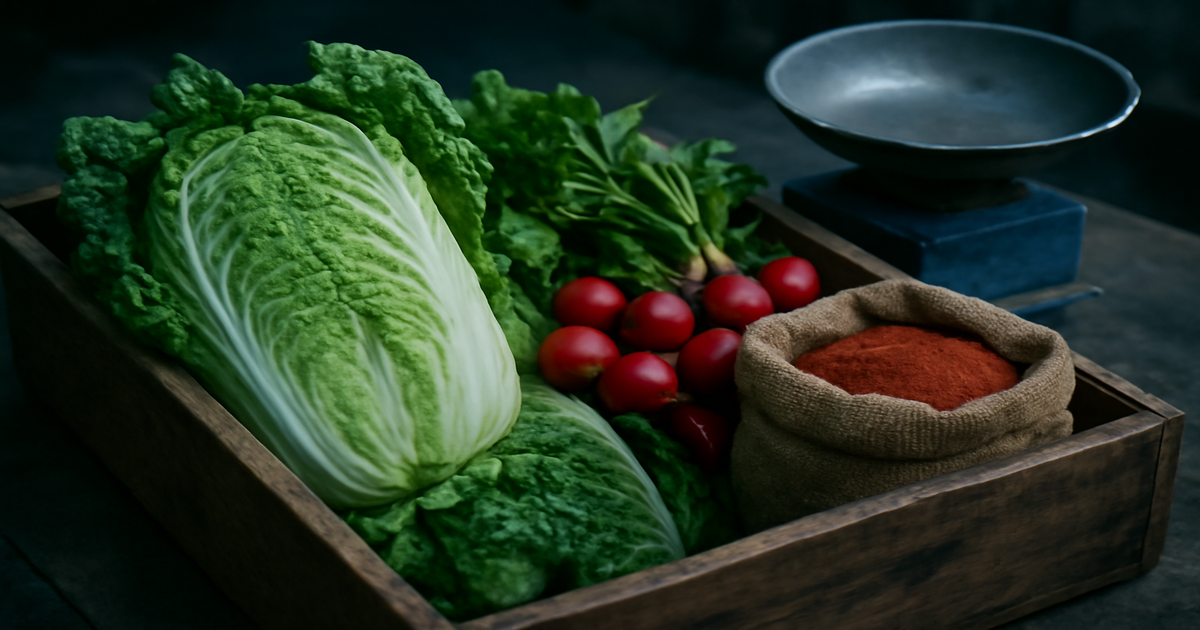
Every autumn, Korean broadcasters run a segment that would puzzle audiences elsewhere: the cost of making kimchi, itemised. Households and community groups buy napa cabbage, radish, chilli powder, garlic and salted shrimp in bulk during kimjang season, and the total is reported the way other countries report petrol prices. The ritual survives because kimchi is a fixed item on the table rather than a discretionary purchase, which makes its ingredients an unusually direct measure of how food inflation feels.
Cabbage is volatile for reasons that have little to do with monetary policy. It cannot be stored for long, so the price reflects the current harvest rather than an inventory. Its summer supply comes almost entirely from highland fields in Gangwon province, where cooler air lets the crop through the hot months, which concentrates a national staple in a small geography exposed to a single weather pattern. A hot, wet late summer damages the heads before they firm up, and by the time the shortfall is visible at wholesale markets there is no second planting that can respond in time. The unusually hot summer of 2024 produced exactly that sequence, and retail cabbage prices in September of that year ran far above the level of a year earlier in the agriculture agency’s daily price surveys.
The state has a standing toolkit for these episodes and uses it predictably. It contracts in advance with growers for a share of the crop, holds reserves it can release into wholesale markets, subsidises retail discounts through supermarket chains, and temporarily suspends tariffs on imported cabbage, most of which comes from China and goes to restaurants and food processors rather than households. The instruments smooth the peak without changing the underlying volatility, and their repeated use has made the autumn intervention itself a routine.
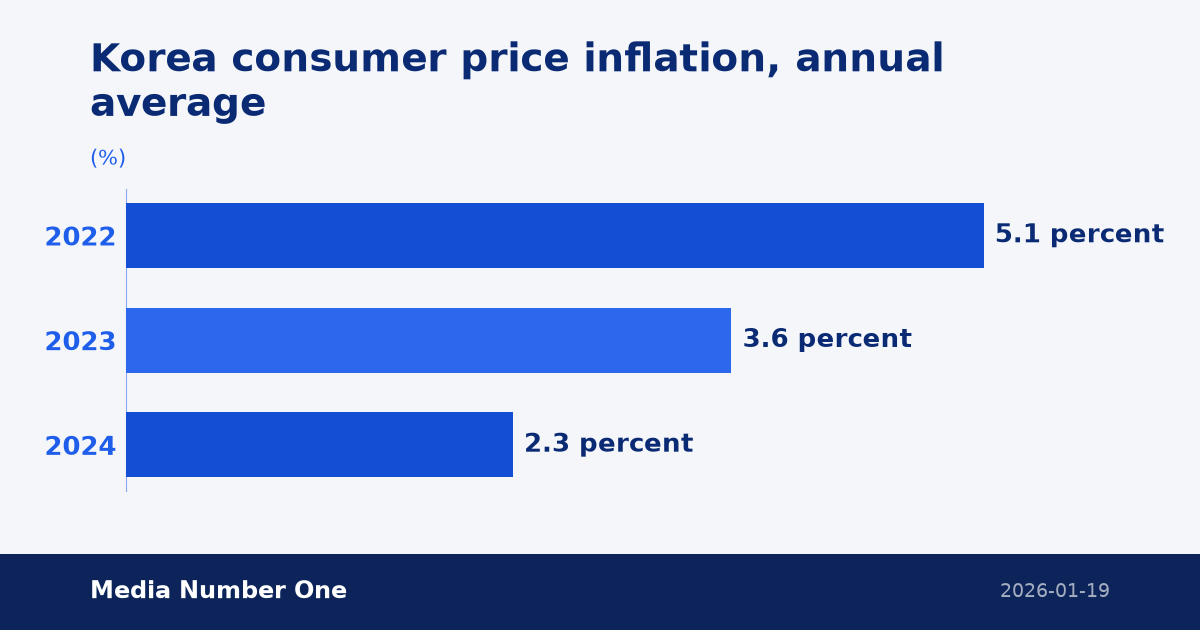
Fresh produce is only the visible part of the problem. Korea’s headline consumer price inflation ran at 5.1 percent in 2022 by the Statistics Korea annual average, the highest in more than two decades, easing to 3.6 percent in 2023 and to roughly 2.3 percent in 2024. Eating out behaved differently: it rose 7.7 percent in 2022 and about 6.0 percent in 2023, and it did not fall back as quickly as the headline index. Processed food followed a similar path. The pattern is familiar from other economies — services prices absorb wage and rent increases and rarely reverse — but it lands hard in a country where eating out is not occasional.
That divergence is what turns grocery arithmetic into a national argument. When restaurant prices move to a new level and stay there, households experience inflation as permanent even after the statistical rate falls, and the gap between the reported index and the perceived one widens. Surveys of inflation expectations in Korea have consistently run above measured inflation, and food is the most cited reason. Governments of every stripe respond with the tools that produce visible prices — discount coupons, reserve releases, tariff suspensions — because the tools that address the underlying cost structure work on a horizon longer than a season.
The cabbage, in other words, is a proxy. Its price measures the weather in Gangwon, the concentration of a staple crop in one region, and the shrinking share of Korean households that make kimchi at home rather than buying it packaged from a manufacturer that hedges its own input costs. What it does not measure, and what households actually feel, is the slower and less reversible increase in the price of a meal someone else cooked.