Korea's charger rollout runs into the apartment parking lot
Korea installed public chargers faster than almost any country, but most of its drivers park in shared apartment garages, and that is where the electric transition is actually decided.
On the headline measure, Korea looks like one of the best-provisioned electric vehicle markets in the world. Environment ministry counts put the national charger stock at roughly 300,000 units by the end of 2023, a number that grew several-fold in five years and gave the country one of the lowest ratios of electric vehicles per charger anywhere. Governments elsewhere cite the figure approvingly. Korean drivers do not, and the gap between the statistic and the experience explains most of what has happened to electric vehicle demand here.
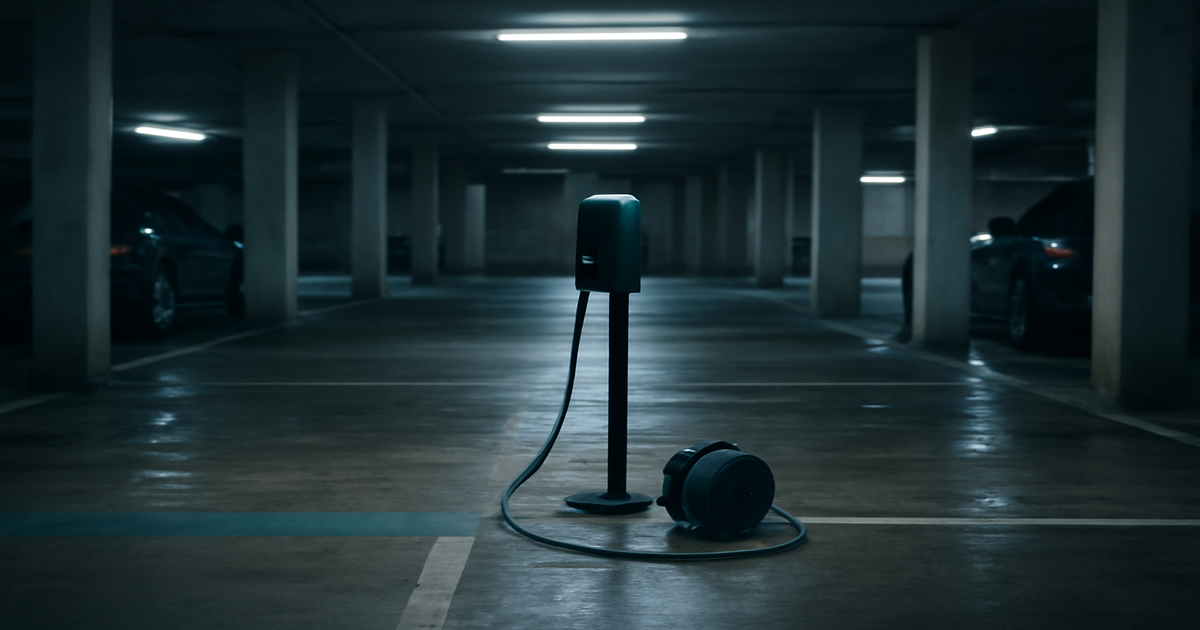
The reason is housing. Well over half of Korean households live in apartment complexes, and their cars sit in shared underground garages that belong to the residents collectively. A charger installed there is not a driveway socket serving one household; it is a piece of common infrastructure that has to be approved by a residents’ representative council, wired into a building whose electrical capacity was specified decades ago for lighting and lifts, and then rationed among however many electric vehicles the complex accumulates. The overwhelming majority of the installed base consists of slow chargers rated around 7 kilowatts, which take most of a night to fill a battery. One such charger genuinely serves one car per night.
That is why the national ratio flatters. A slow charger in a shared garage is a scheduling problem, and Korean apartment complexes have developed an informal etiquette around it — leaving phone numbers on windscreens, moving cars at midnight, and quarrelling over combustion vehicles parked in charging bays, a practice common enough to have acquired its own name. The bays are attractive parking spots regardless of what is plugged in.
Fire risk has made the governance harder. After an underground garage fire at an apartment complex in 2024 drew sustained attention to the behaviour of lithium-ion packs in enclosed spaces, a number of complexes moved to restrict electric vehicles to above-ground parking, to limit charging to a stated share of battery capacity, or to defer new charger installations altogether. Local governments and fire authorities responded with guidance on ventilation, suppression systems and charger placement, but the decision remains with each complex’s residents, which means the rules a driver faces depend on the building they happen to live in.
The subsidy structure has been moving in the opposite direction from the demand it was meant to create. National purchase subsidies per vehicle have been trimmed year after year as the programme spread across more models, with municipal top-ups varying widely and often exhausted early in the year. Charger subsidies have shifted toward fast chargers on highways and in commercial car parks, which are more visible and easier to procure than negotiating with thousands of residents’ councils. Domestic electric vehicle registrations slipped in 2024 after several years of growth — the first clear pause in the transition, and one that came from ordinary consumers rather than fleets.
None of this is a manufacturing problem. Korea builds electric vehicles and the cells that go into them at scale, and its charging hardware makers export. The bottleneck is that the last thirty metres of the charging network run through property law and neighbourhood politics, where the state has few instruments beyond guidance and money. The countries that solve this will be the ones that treat the apartment garage as the unit of policy rather than the charger.