Korea has the world's densest robot workforce and the gap is not closing
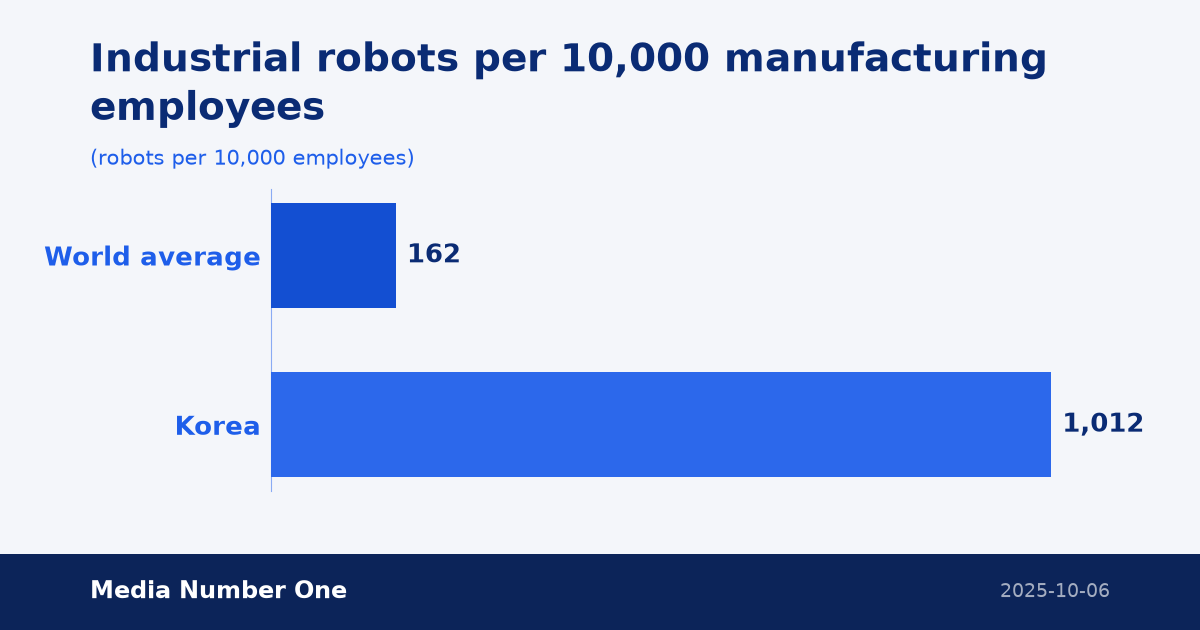
The International Federation of Robotics puts Korea at roughly 1,000 industrial robots per 10,000 manufacturing workers, six times the world average, and the figure says as much about what Korea makes as about how it makes it.
Among the statistics Korea is regularly cited for, robot density is the least contested and among the least understood. According to the International Federation of Robotics, whose World Robotics 2024 report covers installations through 2023, Korea operated roughly 1,012 industrial robots for every 10,000 manufacturing employees. The world average in the same dataset was around 162. Singapore, the only economy in the same order of magnitude, is a city-state with a manufacturing base concentrated almost entirely in electronics. Korea has held the top position in the ranking for more than a decade.
The metric deserves a moment of scrutiny, because it is a ratio and ratios have two sides. Robot density divides the installed base of industrial robots by employment in manufacturing, which means a country can climb the table either by installing machines or by shedding manufacturing jobs. Korea has done both, though the numerator has done most of the work: it has been among the top five markets for annual robot installations for years, typically behind China and Japan in absolute units while far ahead of both per worker.
The structural explanation is more persuasive than any cultural one. Globally, two sectors dominate robot purchasing — electrical and electronics manufacturing, and automotive — and Korea’s industrial base is unusually concentrated in exactly those two. Semiconductor and display fabrication are not merely automated but effectively unstaffable by hand: the cleanroom environments, wafer-handling tolerances and cycle times are outside human capability, so the robots there are not substituting for workers so much as constituting the process. Automotive assembly is the older story, and Korea’s vehicle plants adopted body-shop automation aggressively from the 1990s.
Cost and demography push in the same direction. Korean manufacturing wages rose steeply over three decades, and the statutory reduction of the maximum work week to 52 hours, phased in from 2018 for large employers and extended to smaller ones by 2021, made labour scheduling less elastic in a sector accustomed to absorbing demand spikes through overtime. A shrinking working-age population reinforced the calculation. Where a Korean manufacturer once compared the cost of a robot against the cost of a shift, it increasingly compares the robot against the difficulty of recruiting the shift at all.
The number that matters least for most Korean manufacturers, however, is the national average. Density in Korea is bimodal. Large exporters run some of the most automated plants in the world; small and medium enterprises, which account for the large majority of manufacturing employment, operate at a fraction of that intensity. Successive governments have tried to close the gap through the smart factory programme, which supported the digitisation of tens of thousands of small plants over the past decade. Evaluations of the programme have generally found that most supported facilities reached only its most basic tier — sensors and data collection rather than integrated automation — which is a meaningful improvement over paper, and some distance from a robot cell.
Nor does density translate mechanically into productivity. Korea’s manufacturing output per hour worked remains below the leaders in OECD comparisons, and the persistent productivity gap between large firms and their suppliers is one of the more durable features of the economy. Robots raise output per worker where the process is repetitive, high-volume and stable; much of the small-supplier sector runs short batches to custom specifications, where the payback period is long and the engineering support to maintain a cell is not on staff.
The world will keep quoting the figure, and it is genuinely remarkable. What it describes is a country that automated the parts of its economy that were easiest to automate, extremely thoroughly, and now faces the harder half.