How the China trade changed shape for Korea
For three decades Korea sold China the components its factories assembled, and the relationship was complementary — the deficit Korea ran with China in 2023 marked how thoroughly that has changed.
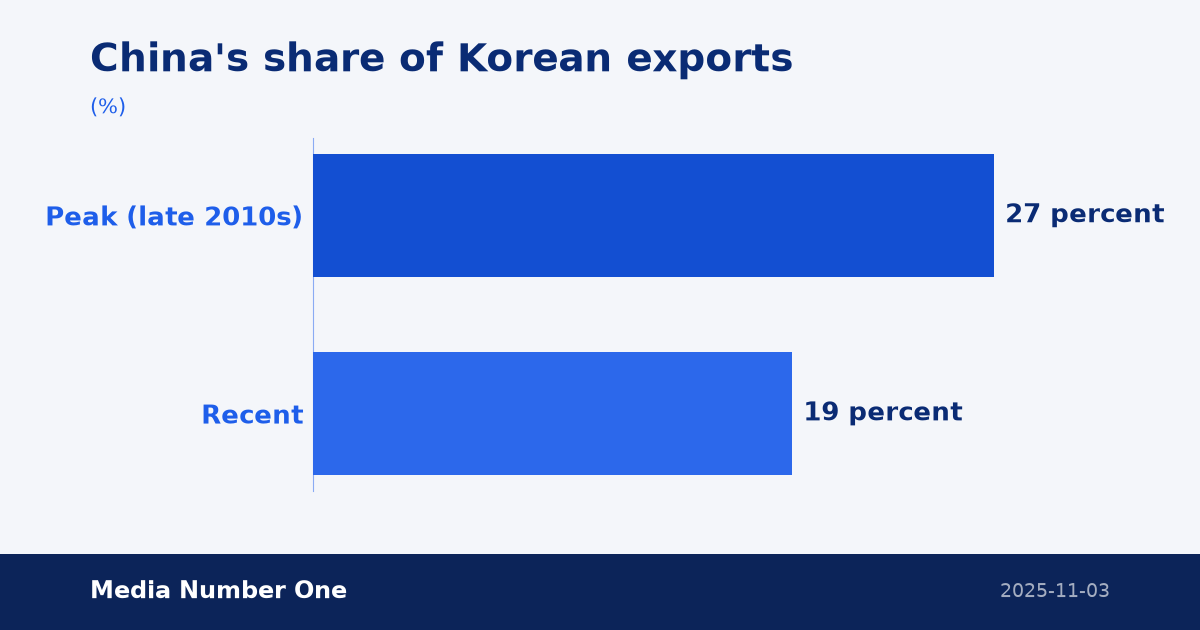
The Korea-China trade relationship was, for most of its life, a textbook case of complementarity. After diplomatic normalisation in 1992, Korean firms sold intermediate goods — memory chips, display panels, petrochemical feedstock, machinery, specialty steel — into Chinese assembly operations that turned them into finished products for export to the West. Korea supplied inputs it was good at making; China supplied scale and labour it had in abundance. The arrangement was profitable enough that China’s share of Korean exports climbed above a quarter by the late 2010s, and Korea ran surpluses with China every year for three decades.
That run ended in 2023. Korean customs figures showed a goods trade deficit with China of roughly $18 billion for the year — the first annual deficit since normalisation and a large one. China’s share of Korean exports had by then fallen to around 19 percent from its peak near 27 percent. The reversal was not caused by a single event. It was the accumulation of a change in what China needs to buy.
The clearest example is displays. Chinese manufacturers moved from importing panels to producing them at scale, and the liquid crystal display business that once anchored Korean exports migrated almost entirely across the Yellow Sea, leaving Korean firms to retreat into higher-margin organic light-emitting diode products. Petrochemicals followed a similar path in reverse: China added enormous ethylene and derivative capacity through the early 2020s, turning itself from Korea’s largest customer into a competitor with surplus product, and Korean petrochemical exporters have faced structurally compressed margins since. Steel, machinery and shipbuilding tell versions of the same story.
Semiconductors are the qualified exception. China remains a large buyer of Korean memory, partly because domestic Chinese capability in advanced memory has lagged and partly because Korean firms operate substantial fabrication capacity inside China itself. But that position is exposed on two sides — to Chinese progress in mature-node and, over time, advanced memory, and to export control regimes that restrict what equipment can be installed in China-based plants. What was once the least contingent part of the relationship has become the most policy-dependent.
Meanwhile the competitive frontier moved into Korea’s own export markets. Chinese firms have become the principal rivals in electric vehicles and lithium batteries, in shipbuilding tonnage, and increasingly in consumer electronics sold to third countries. The competition is no longer for the Chinese market but for the same customers in Europe, Southeast Asia and Latin America — which means the loss to Korean exporters is not fully visible in bilateral trade data at all.
Rebalancing has followed, though its scale should not be overstated. The United States and ASEAN have absorbed a rising share of Korean exports, helped by automobile and battery demand and by large Korean manufacturing investments in North America under American industrial policy incentives. Supply-chain security became an explicit policy objective after episodes that demonstrated how narrow some dependencies were — a 2021 shortage of a diesel exhaust additive whose precursor was sourced almost entirely from China halted logistics for weeks, and export licensing measures on graphite in 2023 raised similar questions for battery makers.
What has not changed is proximity and scale. China remains Korea’s largest single trading partner when imports are counted, supplying intermediate goods and raw materials that no diversification programme can replace quickly. The realistic objective is not decoupling but a different composition: fewer volume commodities exposed to Chinese capacity additions, more products where Korean firms hold a technological lead, and enough redundancy in critical inputs that a licensing decision in Beijing is an inconvenience rather than a stoppage. That transition is expensive, and it is being made under competitive pressure rather than at leisure.