How Korea's convenience stores became the country's most reliable public counter
Korea's 24-hour convenience stores have absorbed banking, parcel, payment and even neighborhood-watch functions that used to belong to bank branches, post offices and nearby residents — making a retail format into de facto public infrastructure.
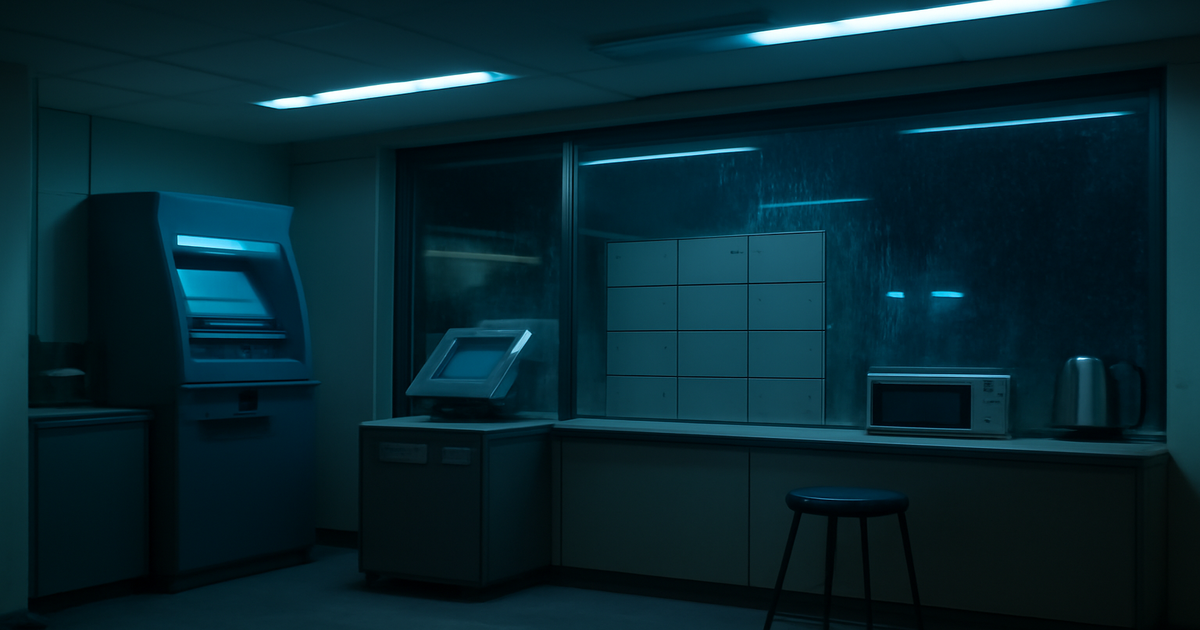
Walk into a Korean convenience store at three in the morning and the shelves are almost beside the point. There is an ATM near the door, a small scale and barcode printer for sending parcels, a screen for paying utility and phone bills, a card reader for topping up a transit card, a locker or shelf stacked with packages waiting for pickup, a microwave, a kettle of hot water, and a counter bench where a delivery rider might be eating a boxed lunch. Retail analysts describe this as service diversification. It is more accurate to describe it as the quiet transfer of civic functions from institutions that keep office hours to a shop that never closes.
The transfer happened in stages, and mostly by market logic rather than policy design. Convenience store chains needed reasons for people to come in more often than a weekly grocery run allowed, and service fees were thin but sticky. Banks, meanwhile, were closing branches as customers moved to mobile apps, and the branch closures fell hardest on neighborhoods where the remaining customers were least likely to use those apps — older residents, rural districts, small industrial areas. Korea Post has faced similar pressure on its rural counters. Into that gap stepped a store already renting space on nearly every corner, already staffed around the clock, already trusted enough to handle cash. Several banks have gone further and placed hybrid teller machines or partnership counters inside chains, which is a striking inversion: the bank now occupies a corner of the shop rather than the other way round.
What makes Korea distinctive is not that convenience stores exist but the density at which they do. The country is routinely described as having one of the highest concentrations of convenience stores per resident in the world, a product of low barriers to franchise entry, high-rise residential density that puts thousands of households within a three-minute walk, and a retirement economy that pushes middle-aged Koreans leaving salaried careers into small-business ownership. That density is what converts convenience into infrastructure. A service is only infrastructure if it is close enough that you do not plan around it.
The social functions are subtler than the transactional ones. In a country where single-person households have become the most common household type and where the phrase for dying alone entered everyday vocabulary, the store is often the one place where a resident is seen daily by someone who would notice an absence. Chains have signed on to child-safety programs that mark participating stores as places a frightened child can enter, and stores frequently serve as informal refuges during heat waves, sudden downpours and late-night walks home. None of this was in the franchise manual. It accrued because the store was open and the neighbors, in the older sense of people who knew your schedule, were not.
The arrangement has costs, and they land on the least protected party. The person absorbing these duties is usually a part-time worker on an hourly wage or an owner working the night shift to avoid paying one, handling cash alone behind a counter that is also a bank, a post office and a bill window. Rising labor costs have pushed chains toward unstaffed or partly unstaffed night operation, with entry by card and shelves under camera. That resolves a payroll problem while dissolving the human element that made the store socially useful in the first place.
That is the tension worth watching. Korea has built a dependable, dispersed, always-open public counter without ever calling it one, which means no one is formally responsible for keeping it open. If the economics of the night shift stop working, the ATM and the parcel scale will likely survive as automated fixtures. The person who noticed you had not come in for three days will not.