Korea's rooftop water tanks are vanishing as the apartment stock ages
Elevated water tanks became standard on Korean apartments because early municipal systems could not push water upward reliably, and their slow removal now marks the shift from building housing to maintaining it.
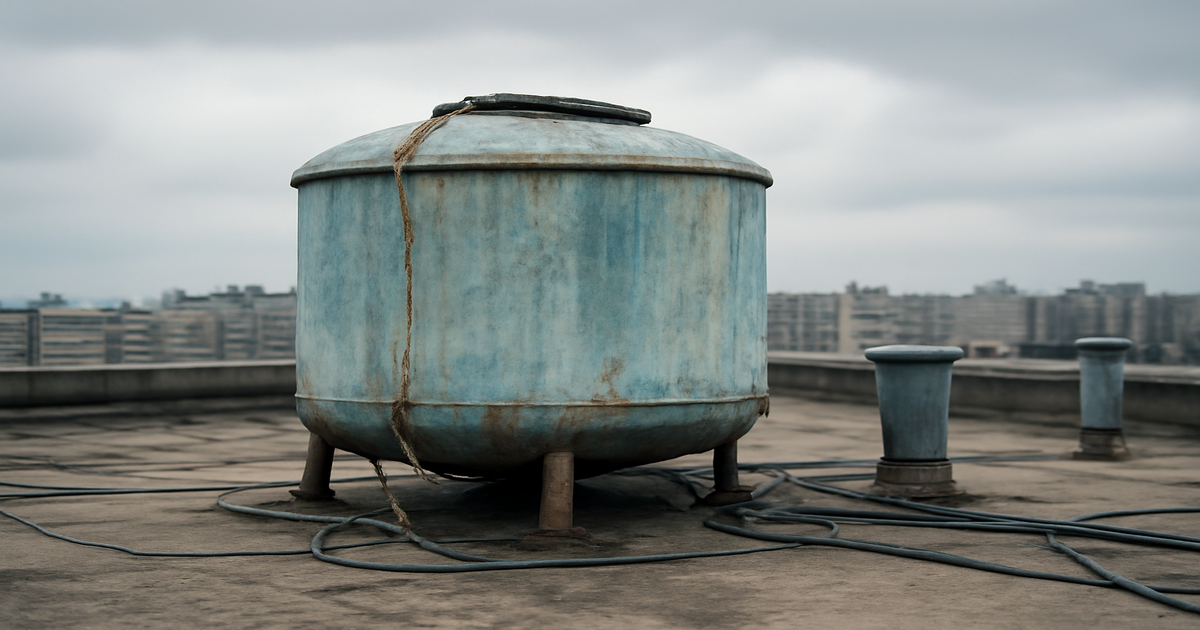
Look at any photograph of a Korean residential district taken between roughly 1975 and 2000 and the skyline has a distinctive punctuation: squat cylinders and boxes perched on flat rooftops, sometimes concrete, more often the pale blue or moss-green fiberglass-reinforced plastic that weathered into a particular chalky pallor. These were 고가수조, elevated water tanks, and they were not decorative. They were the load-bearing solution to a plumbing problem that shaped the vertical logic of Korean apartment life for a generation.
The problem was pressure. Municipal mains in rapidly expanding Korean cities were laid to serve low-rise neighborhoods, and their pressure was calibrated accordingly — adequate for a second-floor tap, marginal for a fifth floor, useless above that. Supply was also intermittent in many districts during the heaviest construction decades, cut for hours during peak demand or repairs. The standard engineering answer, borrowed from Japanese practice and used worldwide, was a two-stage system: water from the main filled a receiving tank at ground or basement level, pumps lifted it to a tank on the roof, and gravity then fed every unit below. The rooftop tank did double duty as a buffer, so a household could still fill a kettle when the mains went quiet. Anyone who lived in an older complex knows the associated sounds — the pump cycling at odd hours, the faint hollow knock in the risers.
The system had a cost, and it was water quality. Stored water sits, warms in summer, and collects sediment; tanks develop biofilm, rust where metal is exposed, and admit dust or insects through poorly sealed hatches. Korean regulation eventually required periodic cleaning and inspection of storage tanks in multi-unit buildings, and the results were publicized often enough to breed a durable public suspicion of tap water in apartments. That suspicion is arguably the single biggest reason Korean households adopted point-of-use filters and bottled water so thoroughly: many residents concluded, not unreasonably, that the water leaving the treatment plant was fine and the water leaving their rooftop was a different substance.
The fix was to eliminate the tank. As municipal pressure improved and booster-pump technology became cheap and quiet, direct-pressure supply — pumping from the main straight into the risers, with no intermediate storage — became the preferred design for new construction and the target of municipal retrofit programs, Seoul’s among the most aggressive. New apartment towers built in the past two decades generally have no rooftop tank at all, which is one small reason the skyline of a redeveloped district reads as cleaner and blanker than the one it replaced. What disappears with the tank is the rooftop as a semi-industrial working surface, the same surface that produced the 옥탑방, the improvised rooftop room that became shorthand in Korean film and fiction for cheap, precarious, sunlit urban living.
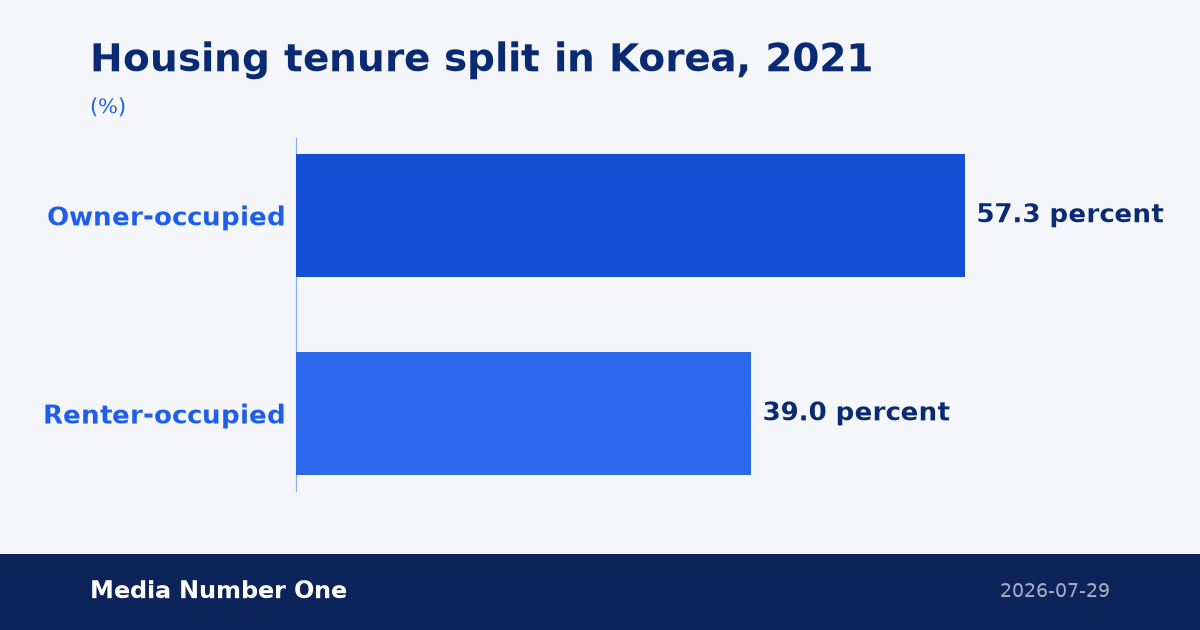
The unevenness of that disappearance is the interesting part. Retrofitting a building from tank-fed to direct supply means work inside the risers and a decision by the ownership body, which is where Korea’s tenure structure bites. Statistics Korea’s 2021 figures put owner-occupancy at 57.3 percent and renter-occupancy at 39.0 percent, and renters rarely drive capital improvements to shared plumbing. Buildings whose owners expect redevelopment within a decade have little incentive to spend on pipes that will be demolished, so the tank stays until the wrecking ball arrives.
That calculus now sits inside a housing market that no longer suffers primarily from shortage. Statistics Korea recorded a housing supply rate of 102.2 percent in 2021, meaning dwellings roughly outnumber households nationally, while the public stock stood at about 1.78 million rental units and 1.53 million households received housing benefit payments the same year. Quantity, in aggregate, has been met; condition has not. The remaining rooftop tanks are a legible index of that gap — a visible marker of which buildings are being maintained, which are waiting to be replaced, and which are simply being left alone.