Korea's lottery sales keep climbing and the reasons are not cheerful
Ticket sales passed six trillion won in the early 2020s and kept rising, funding housing and welfare programmes while serving as a barometer of thwarted mobility.

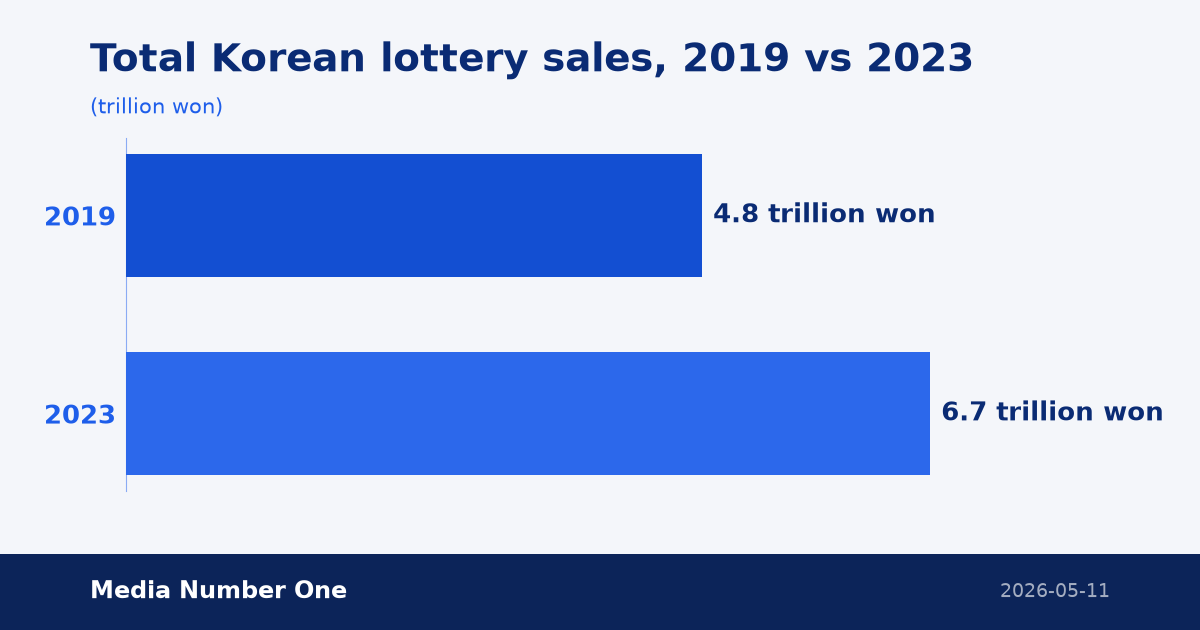
Korea’s lottery business has grown in a remarkably straight line. Total sales across all lottery products, reported annually by the lottery commission under the finance ministry, rose from roughly 4.8 trillion won in 2019 to about 5.4 trillion in 2020, 6.0 trillion in 2021, 6.4 trillion in 2022 and approximately 6.7 trillion won in 2023 — a rise of about 40 percent in four years, through a pandemic, an inflation shock and a slowdown in consumption. Very few consumer categories in the country managed that. The weekly six-of-forty-five draw game accounts for the largest share, with instant scratch tickets and the annuity-style lottery making up most of the rest.
The buyers are not a fringe. Surveys commissioned by the lottery authorities have repeatedly found that a majority of Korean adults — commonly reported in the range of half to sixty percent — bought a lottery ticket at some point in the preceding year, with the typical purchase small and habitual rather than large and occasional. That profile matters for interpreting the growth. Lottery sales in Korea have not risen because a small group of heavy gamblers spends more; they have risen because a very broad, mostly modest, weekly habit spread a little further and a little deeper across the population.
Why it spread is where the numbers stop and the commentary begins, but the commentary is not idle. Lottery growth accelerated through a period when Korean households were absorbing sharp increases in the price of housing relative to income, when survey measures of belief in upward mobility through hard work had been trending down for years, and when the return required to change one’s material position by saving out of wages had come to look, to many people doing the arithmetic, unreachable. A five-thousand-won weekly ticket is not primarily a wager on odds of roughly one in eight million. It is a small, honestly priced purchase of permission to imagine an alternative outcome, and demand for that rises when the ordinary route to the same outcome closes.
The annuity lottery, relaunched in 2020 with a top prize paying seven million won a month for twenty years, is the clearest evidence for that reading. It has been notably popular with younger buyers, and its appeal is structural rather than sentimental: it does not offer a fortune, it offers a permanent replacement for wage income, which is precisely what a labour market with a wide gap between large-firm and small-firm employment does not reliably provide. A prize designed as a salary sells to people whose complaint is about salaries.
Where the money goes is the part of the system least discussed. Roughly half of sales returns to players as prizes — a payout ratio deliberately set below that of casino gaming — with commissions to retailers and operating costs taking a further slice, and the balance flowing into the lottery fund. That fund is a substantial public financing instrument: a large fixed share is allocated by law to the national housing and urban fund, which supports rental housing supply and housing finance for lower-income households, and the remainder is distributed to legally designated recipients and public-interest projects covering low-income welfare, scholarships, support for people with disabilities, culture and the arts, and sports promotion.
The uncomfortable symmetry is difficult to escape. A regressive purchase, concentrated among people who feel furthest from asset ownership, funds programmes whose largest single destination is housing support for people in roughly the same position. Defenders note that the alternative is not zero lottery play but unregulated or offshore gambling, and that the state operator caps prize structures, restricts advertising and funds problem-gambling treatment. Critics note that a public revenue stream which grows when hope shrinks is a poor thing for a government to depend on. Both are describing the same trend line, and it has been pointing the same way for years.