How the apartment complex became the default Korean home
Apartments make up close to two-thirds of Korean housing stock, and the walled complex has become the country's standard unit of neighborhood, prestige and inheritance.
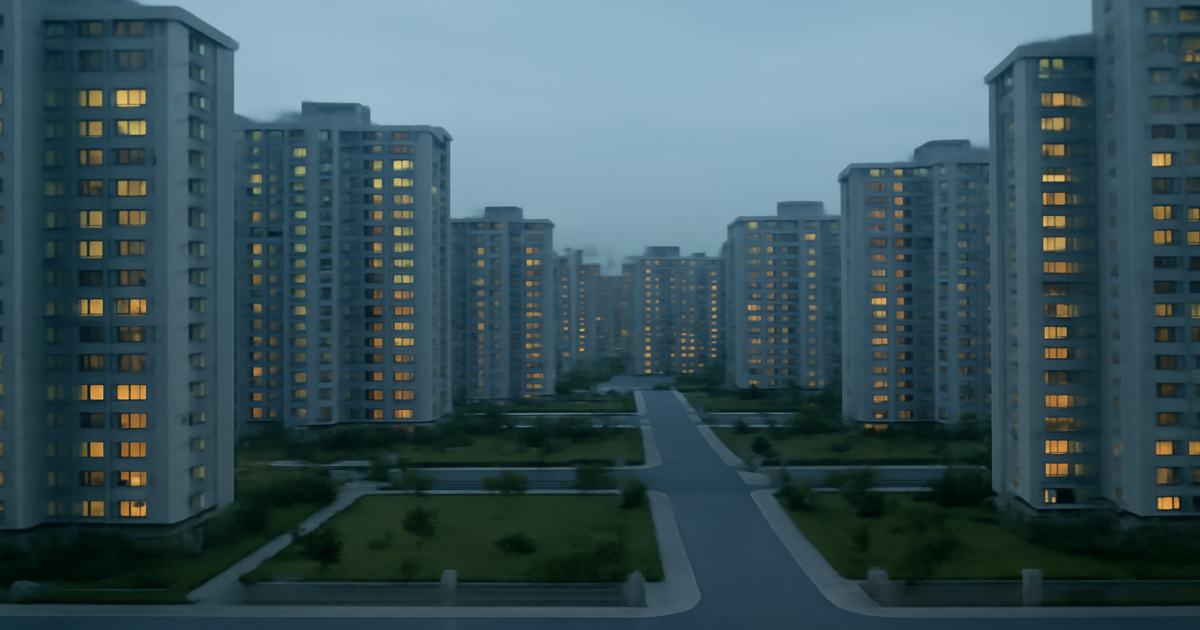
Visitors to Seoul often remark on the repetition of the skyline — rows of numbered towers in matching livery, stretching across river flats and hillsides alike. The pattern is not an accident of taste. According to Statistics Korea’s population and housing census, apartments accounted for roughly 64 percent of the country’s some 19.5 million housing units as of 2023, with detached houses at under a fifth and low-rise multi-household buildings, the category Koreans call villas, at around 13 percent. About half of all households live in one. In most rich countries the apartment is one housing option among several; in Korea it has become the default against which everything else is measured.
The dominance was engineered. Korea urbanized faster than almost any society on record, and the state’s answer to housing millions of new city dwellers was not the individual dwelling but the danji — the planned complex, built in one campaign by a single contractor on a single parcel. The Mapo apartments of the early 1960s were an experiment; the Yeouido and Gangnam projects of the 1970s were a template; the two-million-unit construction drive announced at the end of the 1980s and the first-generation new towns of Bundang and Ilsan turned the template into national policy. Delivering housing in blocks of thousands was simply the fastest instrument available, and speed was the governing priority.
What resulted is less a building type than a small enclosed municipality. A large danji has its own guarded gates and internal roads, its own kindergarten, convenience stores, gym, library room and elder centre, its own management office collecting a monthly fee, and its own elected residents’ representative council with real authority over budgets and contracts. Children can walk to school without crossing a public street. That self-containment is much of the appeal, and much of the critique: the complex privatizes the functions a neighborhood used to perform, and the boundary wall marks where one social world ends and another begins.
Standardization did something else. Because units are built to a small set of floor plans — the 84-square-metre layout is so universal that Koreans call it the national size — an apartment in one complex is genuinely comparable to an apartment in another. Registered transaction prices are published, banks appraise the collateral without argument, and buyers can compare two homes the way they would compare two shares of stock. The construction conglomerates layered a brand hierarchy on top of this liquidity, and the brand name attached to a complex became part of the address itself, carrying a measurable price premium over an identical building without one.
The deepest engine is reconstruction. Korean apartments are typically judged for replacement after about three decades, and a rebuild that raises the permitted floor area can produce enough additional units to fund much of the construction, delivering existing owners a larger home and a higher valuation. That option — not just the flat, but the possibility of the flat becoming a newer and bigger flat — is priced into older complexes in prime districts, which is why safety-inspection standards and the levy on excess reconstruction gains are treated as major economic policy rather than technical building rules, and why owners organize so effectively around them.
The alternatives withered under those conditions rather than by prohibition. Detached houses are illiquid, hard to appraise and expensive to maintain. Villas are heterogeneous, built by small developers, poorly served by the price-comparison machinery, and their reputation suffered further from deposit-fraud cases involving small landlords. Neither offers the security desk, the underground parking or the resale certainty. The result is a housing market with one deep, transparent, heavily traded segment and a residual sector for everyone who cannot enter it — which is the real cost of building a country’s homes so efficiently, and in so nearly identical a shape.