Who will care for Korea's oldest and at what wage
Long-term care insurance turned elder care into a public entitlement in 2008, and the workforce delivering it is aging, low-paid and short of hands as the beneficiary count passes a million.

Korea built its long-term care system quickly and late. The long-term care insurance scheme launched in 2008 as the country’s fifth social insurance, funded by a surcharge on health insurance premiums, a government contribution and a co-payment from the household. It covers home visits, day centres and residential facilities for people assessed into one of several grades of need, and it converted what had been an unpriced family obligation into a service purchased from providers at rates the state sets.
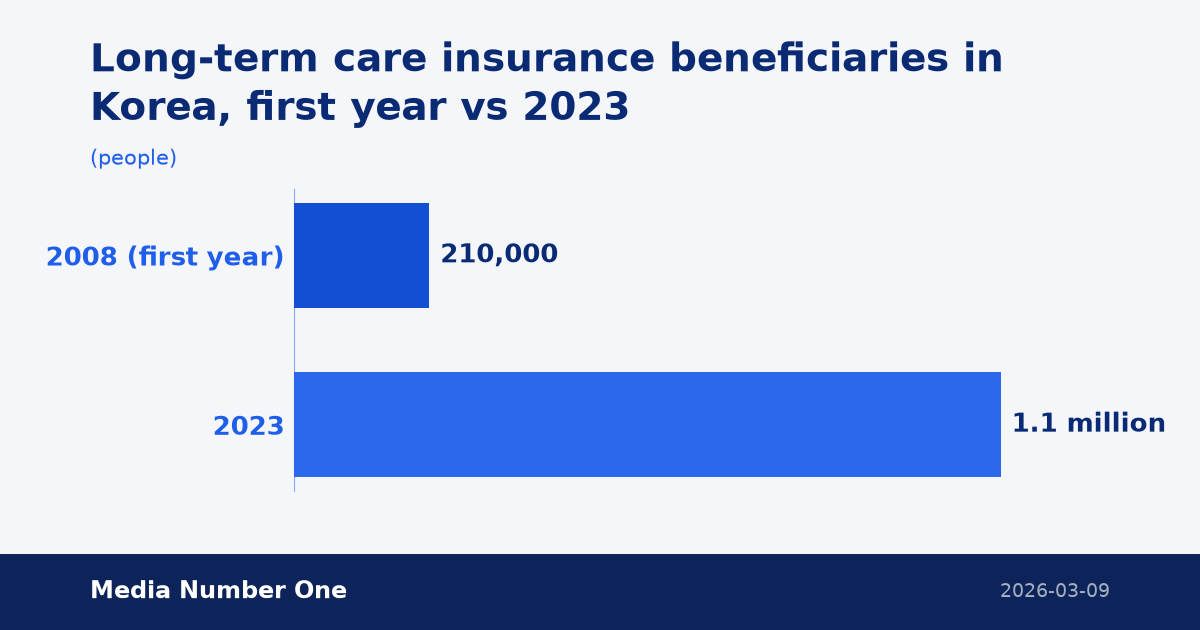
The growth has been steep. National Health Insurance Service figures put beneficiaries at roughly 210,000 in the first year of operation and above 1.1 million by 2023, a fivefold increase driven by an aging population, by successive expansions of eligibility to milder grades of need, and by the simple fact that a service becomes visible once it exists. Spending has grown in step, and the scheme’s finances have been a standing item in public discussion for most of the last decade.
The workers who deliver the care are the system’s constraint. The yoyang bohosa qualification — care worker — can be obtained through a course of a few hundred hours, and the number of people holding the certificate is very large, well into the millions. The number actually working in the job is a small fraction of that, on the order of several hundred thousand. The gap is the whole problem in a single statistic: the credential is easy to obtain and the work is hard to keep.
Pay explains most of it. Because providers are reimbursed at rates fixed in the scheme’s fee schedule, wages track the statutory minimum closely and have little room to rise with experience. Home visiting care is paid by the hour of service, which leaves travel between households unpaid and makes a full day’s earnings depend on how tightly a schedule can be packed. Musculoskeletal injury rates are high, and the workforce is itself old: a large majority of care workers are women, and a substantial share are in their fifties and sixties, which means the people staffing the system are approaching the age of the people it serves.
What the insurance does not cover falls back on families. Hospital attendance — the constant bedside presence Korean hospitals expect during an inpatient stay — sits largely outside the scheme, and families commonly report paying somewhere between 100,000 and 150,000 won a day for a private attendant, an expense that can exceed the medical bill. A pilot programme integrating nursing and care within hospital wards has expanded slowly, held back by staffing rather than by demand. The residual burden falls disproportionately on daughters and daughters-in-law, and surveys of family carers consistently report reduced labour force participation among them.
The proposed answer that generates the most argument is foreign labour. Korea has expanded work permits into some care settings and has run pilots bringing in domestic and care workers from Southeast Asia, and the recurring dispute is whether the statutory minimum wage should apply to them. Those who argue it should point to equal-treatment obligations and to the risk of undercutting an already low-paid domestic workforce; those who argue otherwise point out that at the minimum wage the service remains unaffordable for the households that need it most, which is the reason for the proposal in the first place. Neither side disputes the arithmetic.
That arithmetic is about to get harder. The large cohort born between the mid-1950s and early 1960s begins reaching the ages of highest care need during the 2030s, at which point beneficiary numbers rise while the working-age population that funds the scheme continues to shrink. Every design question the system has deferred — what care workers are paid, who performs the work, and what families are still expected to absorb — becomes binding at the same time.