Korea counts its lonely deaths and struggles to prevent them
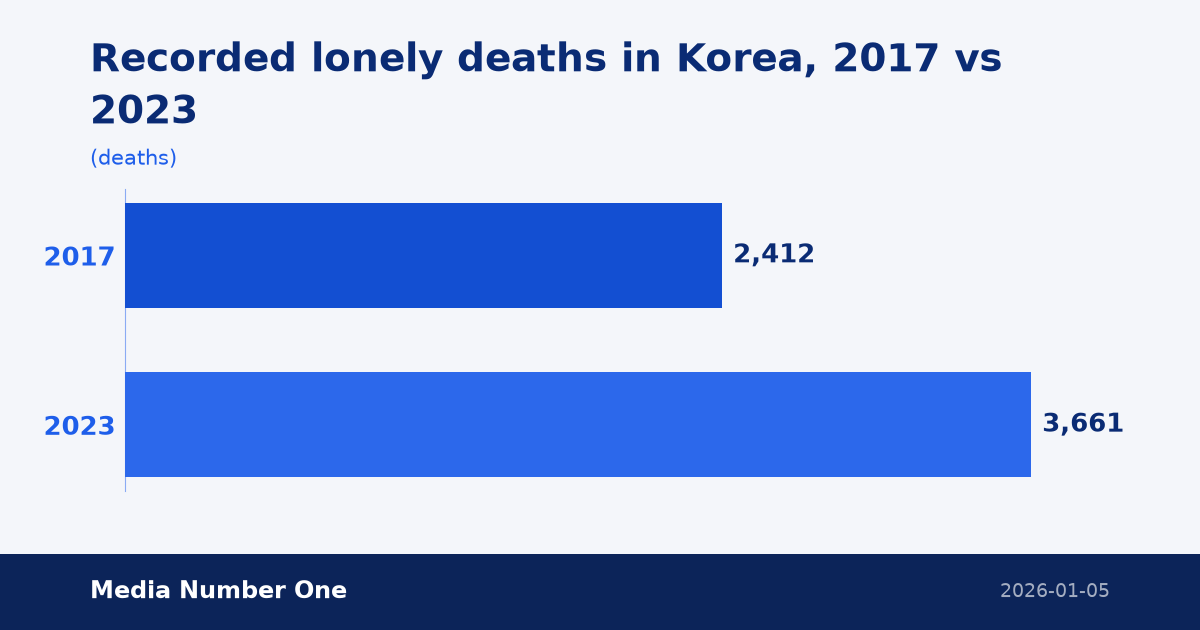
Korea recorded more than 3,600 deaths in isolation in 2023 by the welfare ministry's count, a tally dominated by middle-aged men and shaped as much by how the state chose to define the problem as by the problem itself.
Korea had a word for it long before it had a number. Godoksa — a death that goes unnoticed, the body found days or weeks later — entered ordinary speech through news coverage of single rooms and studio flats in the 2000s. It became a statistical category only in 2021, when the Act on the Prevention and Management of Lonely Deaths took effect and obliged the Ministry of Health and Welfare to survey the phenomenon every five years and to fund programmes intended to reduce it.
The first survey, published at the end of 2022, worked backwards through police and administrative records. It counted 2,412 such deaths in 2017, rising to 3,378 in 2021. A subsequent ministry tally extended the series to 3,559 in 2022 and 3,661 in 2023. Set against roughly 350,000 deaths a year in Korea, that is about one in a hundred. The trend line carries more information than the level, because the definition is deliberately narrow: it captures people living alone who were discovered after an interval, and misses cases where a landlord or neighbour happened to knock early. Changes to the counting rules across editions of the survey mean year-to-year comparisons should be read with some caution.
The composition is what surprised people who expected a story about the very old. Men accounted for roughly five in six cases in every year the ministry examined, and men in their fifties and sixties alone made up more than half the total. Korea’s poverty statistics point emphatically at old age; its isolation statistics point at middle age. The two problems overlap but are not the same problem, and the programmes built for one do not automatically reach the other.
The explanation most often advanced by researchers is structural rather than psychological. Men who lost stable employment during successive rounds of industrial restructuring, and men who separated from their families, tended to lose their social ties in a single stroke, because those ties ran through the workplace and the household rather than through neighbourhoods or congregations. Housing reinforces the pattern: the low-cost studio flats and goshiwon rooms that absorb single men in their fifties are designed for anonymity, with no shared spaces and high turnover among neighbours. Single-person households, which Statistics Korea has put at more than a third of all households, are the pool from which these cases are drawn, though only a small fraction of that pool is at risk.
Detection has become the operational focus. The social security information service screens administrative data — unpaid electricity, gas and water bills, health insurance arrears, disconnected phone lines — to flag households in possible crisis, and passes lists to local officials for visits. Municipalities have layered on sensors that report electricity draw and door movement, meal delivery schedules that double as welfare checks, and networks of shopkeepers and building managers asked to notice absences. The methods work in the sense that they surface people. What follows is harder: a visit is a request for consent, and the households most at risk are disproportionately those that decline it.
The first national basic plan on lonely deaths, adopted in 2023, set a target of cutting the rate by a fifth by 2027 and expanded the pilot programmes accordingly. Whether that target is met will depend less on the sensors than on whether the state can offer middle-aged men something to be connected to. Detection finds people after the fact. The count itself is a measure of the social ties that were not there, and no monitoring system creates them.