Dawn delivery bought Korean shoppers speed and moved the cost somewhere else
Ordering groceries at midnight and finding them at the door before breakfast depends on apartment density, owned warehouses, cold chain engineering and night labour, in roughly that order.
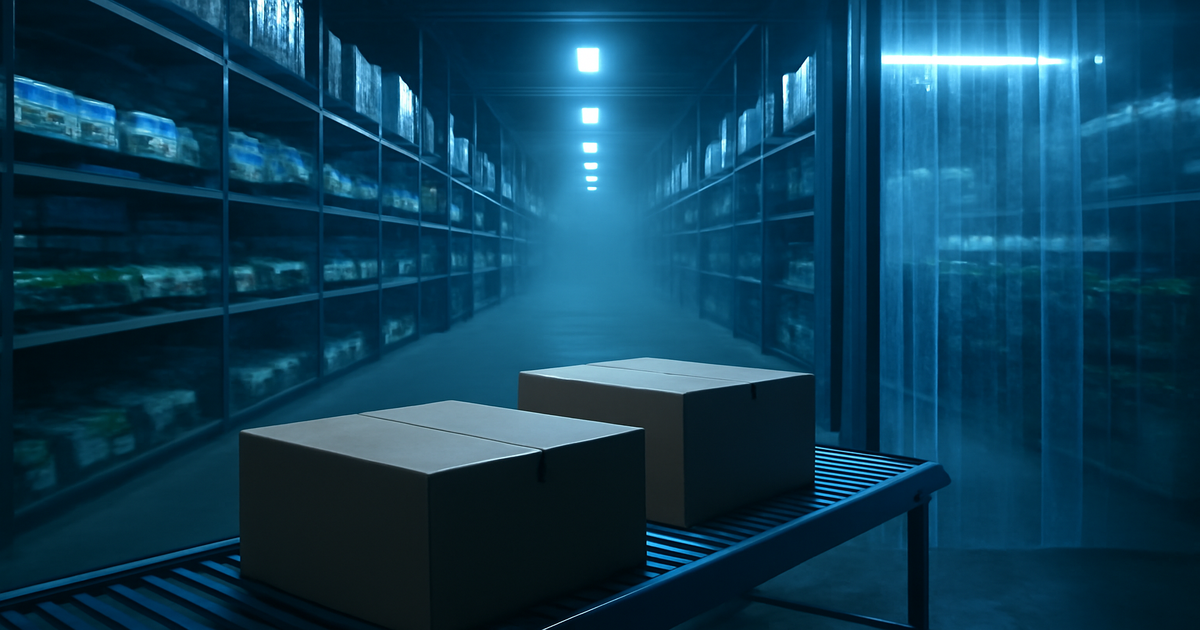
The proposition is simple enough to sound trivial: place a grocery order late in the evening and the box is outside the door before seven the next morning. Market Kurly introduced the service in 2015, Coupang built a large version of it from 2018, and supermarket chains and convenience-store operators followed. Industry estimates put the dawn-delivery segment in the low trillions of won annually by the early 2020s, from essentially zero a few years earlier. Korean consumers treat it as ordinary. Almost nowhere else has copied it, and the reasons are structural rather than technological.
The first and largest is population geography. More than half of Koreans live in the Seoul metropolitan area, and the great majority of households live in apartment complexes where hundreds of front doors share an elevator bank. Last-mile cost is governed almost entirely by drop density — the number of deliveries a courier completes per hour of driving. In a dense apartment estate a driver completes dozens of drops without moving a vehicle; in a low-density suburb the same route is a morning’s work. Attempts to transplant overnight grocery delivery into detached-housing markets have run into that arithmetic.
The second is that the model requires owning inventory, which is not what platform companies normally want to do. Marketplace intermediaries take a commission and hold nothing; a promise of delivery before dawn cannot survive a third-party seller’s dispatch schedule. The Korean operators therefore built warehouses and bought stock, in a capital programme running into the trillions of won over a decade, positioned so that most of the population sits within a short drive of a fulfilment centre. The application is the visible part. The asset is the property portfolio.
The third is refrigeration, which is where the engineering lives. Fresh food sitting at ambient temperature between a night-time pick and a pre-dawn drop is a food-safety problem, so the operators built chilled and frozen picking zones, multi-temperature vehicles and insulated packaging systems. Early versions used large quantities of expanded polystyrene and gel packs; after sustained criticism of the waste around the turn of the 2020s, operators shifted toward recyclable paper insulation and reusable containers, which improved the environmental profile without reducing the cost.
There is a fourth constraint that is less visible and arguably the most demanding. A dawn service has an order cut-off, which means picking begins when replenishment is no longer possible. Every unit of stock in the building that evening is either sold or, in the case of fresh produce, largely lost. The entire operation therefore rests on demand forecasting at the level of individual products and individual regions, learned from history and adjusted for weather, holidays and promotions. Getting it wrong is spoilage, and spoilage is a direct subtraction from a thin margin. This is a considerable part of why the segment favours a few large operators: forecasting accuracy improves with data volume, and the smaller entrant carries the same waste risk on worse information.
The last cost is human and it falls at the least convenient hours. Dawn delivery runs on night shifts in warehouses and on the road, work that commands wage premiums and carries documented health consequences. A series of deaths among parcel and fulfilment workers around 2020 attributed to overwork produced a national social agreement in 2021 on parcel workers’ duties and workloads, and pushed night-work conditions into the regulatory conversation. The industry has since added staffing, shift limits and monitoring; the underlying tension has not gone anywhere, because the service is defined by operating during the hours when labour is scarcest and most expensive.
The consumer experiences a convenience that appears nearly free. The cost is entirely real. It sits in warehouse capital, packaging, unsold produce and overnight wages, and the durable question about the category is not how fast it can go but which of those lines absorbs the pressure when growth stops paying for them.